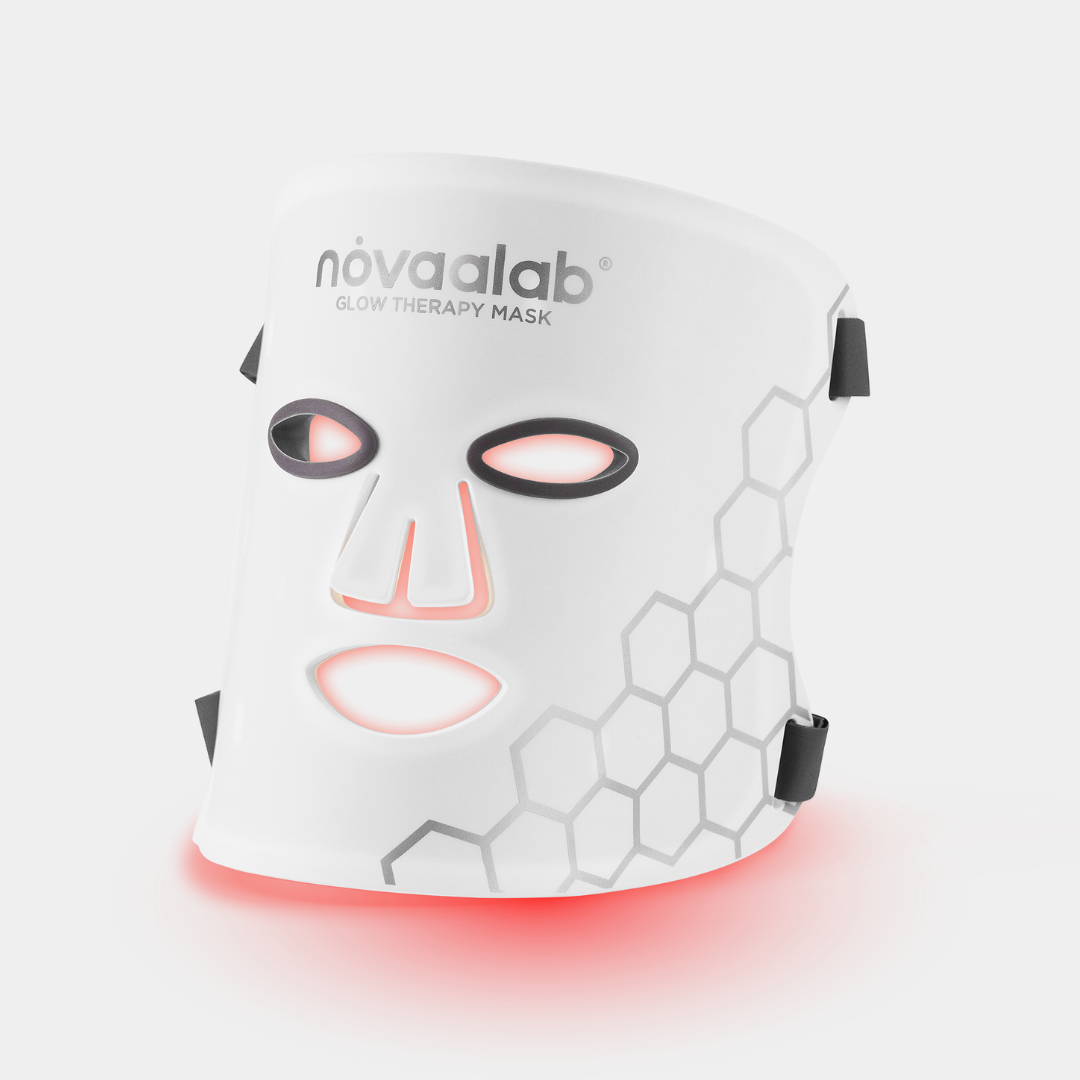
Imagine crossing the threshold of your home after a relentless day, leaving the noise, demands, and blue-light glare of the modern world behind. As you retreat into your personal sanctuary, you slip on a silent, warm, photon-rich shield that cocoons your face in a restorative amber glow. This is more than a skincare routine; it is a ritualistic transition into deep cellular recovery and nervous system calm. For years, premium light therapy was locked behind the clinical doors of high-end dermatologists. Today, the Novaa Glow Therapy Mask brings that exact clinical-grade photobiomodulation (PBM) directly into your private sanctuary. But to truly unlock the transformative power of near-infrared (NIR) light, one must move past generic marketing claims and understand the rigorous biophysics of clinical dosimetry. NovaaLab
Chromophore Selection: Why NIR Beats Red for Dermal Targets
The foundation of facial PBM lies in target selection. While visible red light (630–660 nm) is highly effective for epidermal issues, it lacks the penetrative power required to stimulate the deep dermal matrix where collagen synthesis and cellular repair originate. To achieve true systemic rejuvenation, we must target the primary mitochondrial chromophore: cytochrome c oxidase (CCO).
According to classic photobiology research (Hamblin, 2017), CCO absorption peaks at 810 ± 10 nm (at the copper center CuA) and 830 ± 5 nm (at the CuB binuclear center). When NIR photons at these exact wavelengths strike the mitochondrial membrane, they trigger the dissociation of nitric oxide (NO) from the binuclear center. NO acts as a competitive inhibitor of oxygen; by displacing it, photon capture allows oxygen to bind freely, boosting mitochondrial membrane potential and increasing ATP synthesis by 10 to 15 times. This rapid influx of energy revitalizes cellular metabolism and accelerates tissue regeneration.
While visible red light scatters heavily in the superficial layers of the skin, NIR light in the 810–850 nm range operates within the optical window of human tissue. At these wavelengths, absorption by water and melanin is minimized, allowing photons to penetrate up to several millimeters deep into the reticular dermis to activate fibroblasts directly.
Irradiance at the Skin: Overcoming the Inverse-Square Law
Many consumer-grade light panels and loose-fitting masks claim high power output, but they fail to deliver therapeutic energy due to the physics of light propagation. The inverse-square law dictates that light intensity decreases proportionally to the square of the distance from the source. A panel positioned just three inches away from the face loses up to 90% of its therapeutic irradiance. Furthermore, standard LEDs emit light at wide exit angles (typically 120 degrees), causing photons to scatter laterally into the air instead of penetrating the skin.
To achieve the required therapeutic threshold of ≥5 mW/cm² at the target tissue, a device must maintain close, uniform contact with the skin. The contour-conforming medical silicone of the Novaa Glow Therapy Mask places medical-grade LEDs less than 2 millimeters from the stratum corneum. This proximity minimizes air-gap scattering and ensures that the target tissue receives the precise, concentrated dosage required for mitochondrial activation without thermal damage or lateral energy loss. NovaaLab
Fluence Mapping Across Facial Zones
Human facial anatomy is highly heterogeneous, requiring careful dosage management (fluence mapping) to achieve optimal results. Dermal thickness, vascularization, and melanin density vary significantly across different facial zones.
For example, the glabellar region (the forehead and brow area) features thicker skin and higher muscle density, meaning it requires a higher cumulative dose of light to reach deeper layers. Conversely, the periorbital region (around the eyes) has incredibly thin, delicate skin with minimal subcutaneous fat.
To target a therapeutic fluence of 3–10 J/cm² (as verified by ANSI Z136.1 and ISO 10993 standards), you must map your exposure times based on the device's exact output. Delivering a stable 10 mW/cm² directly to the skin for 10 minutes yields a total fluence of 6 J/cm²—the exact sweet spot for stimulating dermal fibroblasts to produce type-I collagen without inducing cellular fatigue.
Frequently Asked Questions
Why is near-infrared light better than visible red light for deep skin rejuvenation?
While visible red light is effective for epidermal issues, it lacks the penetrative power needed to reach the deep dermal matrix where collagen synthesis begins. In contrast, near-infrared light in the 810–850 nm range minimizes absorption by water and melanin, allowing photons to penetrate several millimeters deep into the reticular dermis. This deep penetration allows the light to directly activate fibroblasts to stimulate true systemic rejuvenation.
How does near-infrared light therapy stimulate recovery at a cellular level?
Near-infrared photons target the primary mitochondrial chromophore, cytochrome c oxidase, to trigger the dissociation of nitric oxide, which acts as a competitive inhibitor of oxygen. Once nitric oxide is displaced, oxygen can bind freely, which boosts mitochondrial membrane potential and increases ATP synthesis by 10 to 15 times. This rapid influx of energy revitalizes cellular metabolism and accelerates tissue regeneration.
Why does the distance of a light therapy mask from the face matter?
Due to the inverse-square law, light intensity decreases proportionally to the square of the distance from the source, meaning a panel placed just three inches away from the face loses up to 90% of its therapeutic irradiance. Additionally, standard LEDs emit light at wide 120-degree angles, causing photons to scatter laterally. To achieve the necessary therapeutic threshold of at least 5 mW/cm² without lateral energy loss, a device must maintain close, uniform contact with the skin.
How does the Novaa Glow Therapy Mask address the problem of light scattering?
The Novaa Glow Therapy Mask is constructed from contour-conforming medical silicone that positions its medical-grade LEDs less than 2 millimeters from the skin's surface. This close proximity virtually eliminates the air-gap, preventing lateral light scattering and energy loss. Consequently, it delivers a precise and concentrated clinical irradiance directly to the target tissue without causing thermal damage.
What is the recommended treatment time to stimulate collagen production with a 10 mW/cm² device?
To properly stimulate dermal fibroblasts to produce type-I collagen without causing cellular fatigue, you should aim for a therapeutic fluence of 3–10 J/cm². Applying a stable output of 10 mW/cm² directly to the skin for exactly 10 minutes delivers a total fluence of 6 J/cm². This dosage represents the ideal sweet spot for achieving optimal cellular rejuvenation.
Pros
- Precise clinical-grade wavelengths (660nm and 850nm) targeted directly to the dermis
- Flexible medical-grade silicone ensures perfect contouring to eliminate distance-based power loss
- Completely non-invasive, thermal-safe, and designed to fit into a relaxing daily wellness routine
Cons
- Requires consistent daily 10-minute sessions to build cumulative mitochondrial charge
- Premium pricing reflecting professional-grade engineering and certified outputs
Technical Verdict
The physics of photobiomodulation are uncompromising: distance is the enemy of dosage. By utilizing flexible, skin-conforming silicone to eliminate the air-gap, this medical-grade device delivers the precise clinical irradiance required to trigger true cellular recovery and mitochondrial rejuvenation.
→ View Specs & Pricing