
Infrared Sauna Running Cost Calculator: Electricity Per Session
Imagine stepping into your own private sanctuary at the end of a chaotic day—a warm, timber-scented retreat where deep infrared heat melts away stress, targets muscle soreness, and prepares your mind for a night of restorative sleep. Creating this personal escape inside your home is the ultimate lifestyle upgrade, but high-end recovery shouldn't come with high-energy bill anxiety. By using an infrared sauna running cost calculator: electricity per session is a key phrase, you can easily determine the exact electricity per session to justify this wellness investment. Let’s break down the physical laws, thermal dynamics, and real utility rates that prove why home saunas are both highly efficient and remarkably affordable.
How Much Electricity Does an Infrared Sauna Use Per Session?
A typical infrared sauna uses between 1.5 kW and 6 kW of power, with most 2-person models consuming around 1.5-2 kW and larger 4-6 person units drawing 3-6 kW. Understanding your infrared sauna electricity consumption starts with examining the physical heater technology. Modern systems utilize advanced heating elements that maximize thermal transfer efficiency. When looking at wattage per session, a smaller personal cabin requires significantly less power than commercial units.
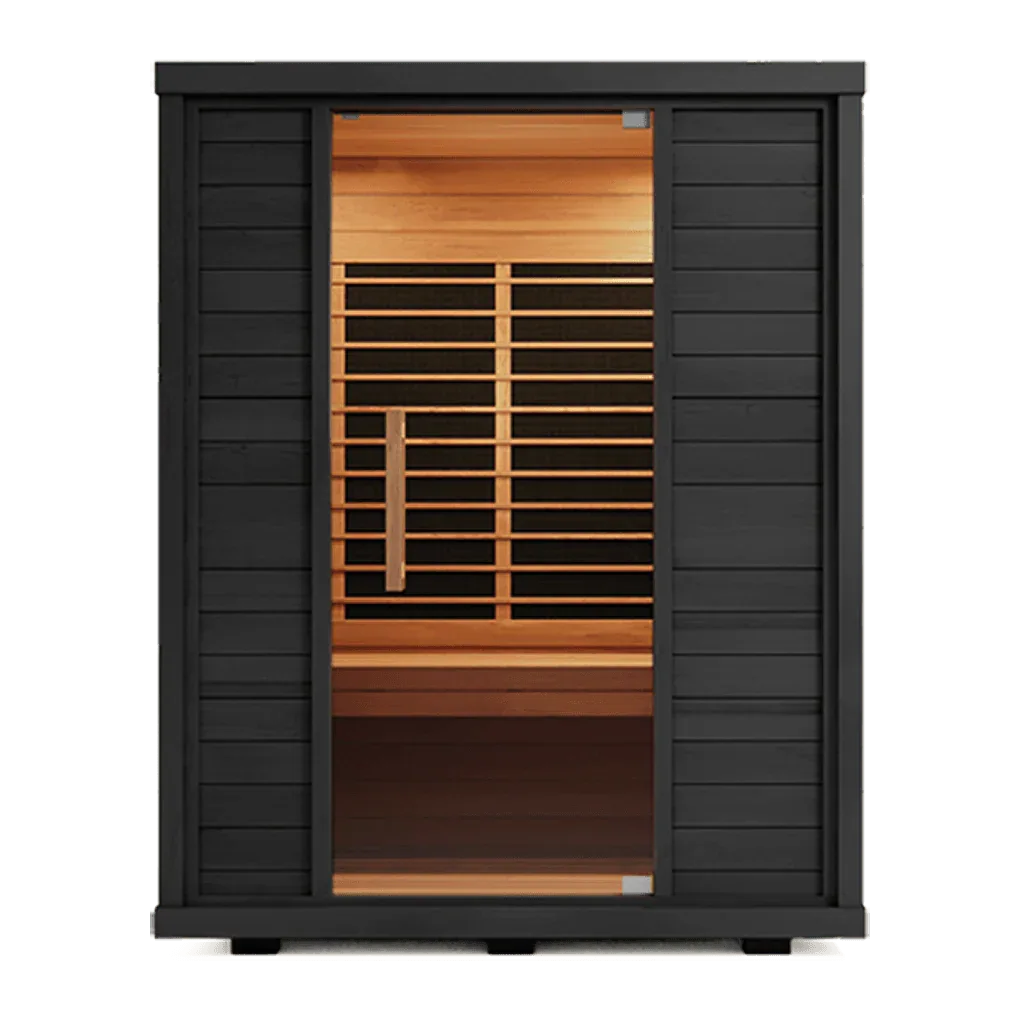
For example, the Sunlighten sauna wattage for their mPulse 2-person model is rated around 1.6 kW, while a classic JNH Lifestyles sauna wattage for a comparable 2-person model draws approximately 1.5 kW. This means running these cabins for a standard 30-to-45-minute session uses only a fraction of the power needed by typical home appliances like central air conditioning or clothes dryers. High-end cabins like the Sun Home Equinox Sun Home Saunas leverage these efficient parameters to keep operational overhead to a minimum.
How to Calculate Your Infrared Sauna Running Cost: Electricity Per Session
To calculate the cost per session, multiply your sauna's wattage by session hours, divide by 1000, then multiply by your local electricity rate: (Watts × Hours) / 1000 × cost per kWh. This simple formula provides a transparent way to calculate infrared sauna cost without any guesswork. Because most utility companies bill by the kilowatt-hour (kWh), converting your device's raw wattage is the first step in creating a reliable session cost calculator.
Using a 4.5 kW sauna for 45 minutes costs exactly $0.47 per session when utilizing the national average rate. Here is how that math breaks down: first, convert the session time to hours (45 minutes = 0.75 hours). Next, multiply 4.5 kW by 0.75 to get 3.375 kWh of energy consumed. Finally, multiply this by the national average cost per kWh of $0.14 to arrive at $0.47 per session. This straightforward electricity cost formula makes it easy to forecast your ongoing wellness budget.
Infrared Sauna Running Cost by State: Where Electricity Is Cheapest
Running an infrared sauna can cost as little as $0.11 per session in Texas and as much as $0.22 per session in California, based on state electricity rates and average usage. Because electricity rates by state vary wildly across the United States, your geographic location plays a major role in your ongoing operational costs. Let's look at how regional differences impact your infrared sauna cost by state when running a standard size cabin.
Below is a regional cost breakdown for a high-performance 4.5 kW sauna operating for a 45-minute session:
| State | Average Rate per kWh | Cost Per 45-Min Session |
|---|---|---|
| Texas | $0.11 | $0.37 |
| US Average | $0.14 | $0.47 |
| New York | $0.18 | $0.61 |
| California | $0.22 | $0.74 |
While a California sauna cost is roughly double a Texas sauna cost, even the most expensive regions remain highly affordable, coming in at under one dollar per session.
How the Options Compare
When choosing the right wellness setup, balancing performance, space, and energy usage is key. Below we compare two premium options and a portable alternative to find the perfect fit for your lifestyle and budget.
| Metric | Sun Home Equinox Sun Home Saunas | Infrared Sauna Blanket [AFFILIATE:higherdose:sauna-blanket:comparison-card] | Sunlighten mPulse |
|---|---|---|---|
| Price Range | $6,000 - $8,000 | $400 - $600 | $6,000 - $10,000 |
| Best For | Premium full-cabin sanctuary | Portable space-saving recovery | Advanced multi-spectrum customization |
| Key Limitation | Requires dedicated floor space | Single-person lying posture only | High initial capital cost |
The Sun Home Equinox is the clear winner for luxury home installations, while the Infrared Sauna Blanket wins for budget-conscious apartments.
Infrared Sauna vs. Traditional Sauna vs. Cold Plunge: Cost Comparison
Infrared saunas are significantly cheaper to run than traditional saunas, costing about $0.47 per session compared to $0.50-$1.50 per session, and are similar to cold plunge chillers at $0.50-$1.00 per session. When evaluating infrared sauna vs traditional sauna cost, the difference lies in physics. Traditional Finnish saunas require large 6 kW to 9 kW stoves to heat the air to extreme temperatures, requiring up to an hour of pre-heating.
Meanwhile, cold plunge chiller electricity cost is comparable but continuous, as a 1/4 to 1/2 HP chiller must run periodically throughout the day to keep the water temperature stable. Other modern wellness tools like the Novaa Pro NovaaLab red light therapy pad run on incredibly low wattages, costing just pennies. Overall, far-infrared technology remains the most thermodynamically efficient method for intense sweat therapy, keeping your aggregated biohacking gear costs perfectly manageable.
How to Reduce Your Infrared Sauna Electricity Bill by 30%
You can cut your infrared sauna electricity bill by up to 30% by using a timer to run during off-peak hours, adding insulation, and choosing carbon heaters over ceramic for faster warm-up and better heat retention. To reduce infrared sauna electricity cost, take advantage of your utility company's time-of-use scheduling. Running your sauna during designated off-peak sauna use windows can easily drop your bills.
Additionally, focusing on thermal dynamics will optimize your sessions:
- Improve Insulation: Position your cabin away from drafty windows and concrete basement floors to reduce warm-up time.
- Carbon vs Ceramic Heater Efficiency: High-emissivity carbon panels heat up faster and distribute heat more evenly than ceramic tubes, cutting down pre-heating duration.
- Utilize Smart Power Plugs: Implement an energy-monitoring timer to ensure the heaters automatically cut off the moment your session is complete, preventing accidental idle draw.
Monthly Cost of Daily Infrared Sauna Use: Is It Affordable?
Using an infrared sauna daily for 30 minutes costs approximately $6.30 per month in an average US state, making it an affordable addition to your wellness routine. When assessing long-term infrared sauna affordability, looking at monthly infrared sauna cost puts things in perspective. Daily use of a personal 2-person cabin is easy on the wallet.
FAQs
How much does it cost to run an infrared sauna for 30 minutes?
At the US average rate of $0.14/kWh, a 2-person sauna (1.5 kW) for 30 minutes costs about $0.11, while a 4-person sauna (4.5 kW) for 30 minutes costs about $0.32.
Can I plug an infrared sauna into a regular outlet?
Most 2-person models requiring under 15 amps can plug into a standard 120V household outlet. Larger units may need a 240V dedicated circuit.
How can I reduce my infrared sauna electricity bill?
Use a timer for off-peak operation, improve insulation, and opt for carbon heaters which warm up faster than ceramic ones. These steps can cut costs by up to 30%.