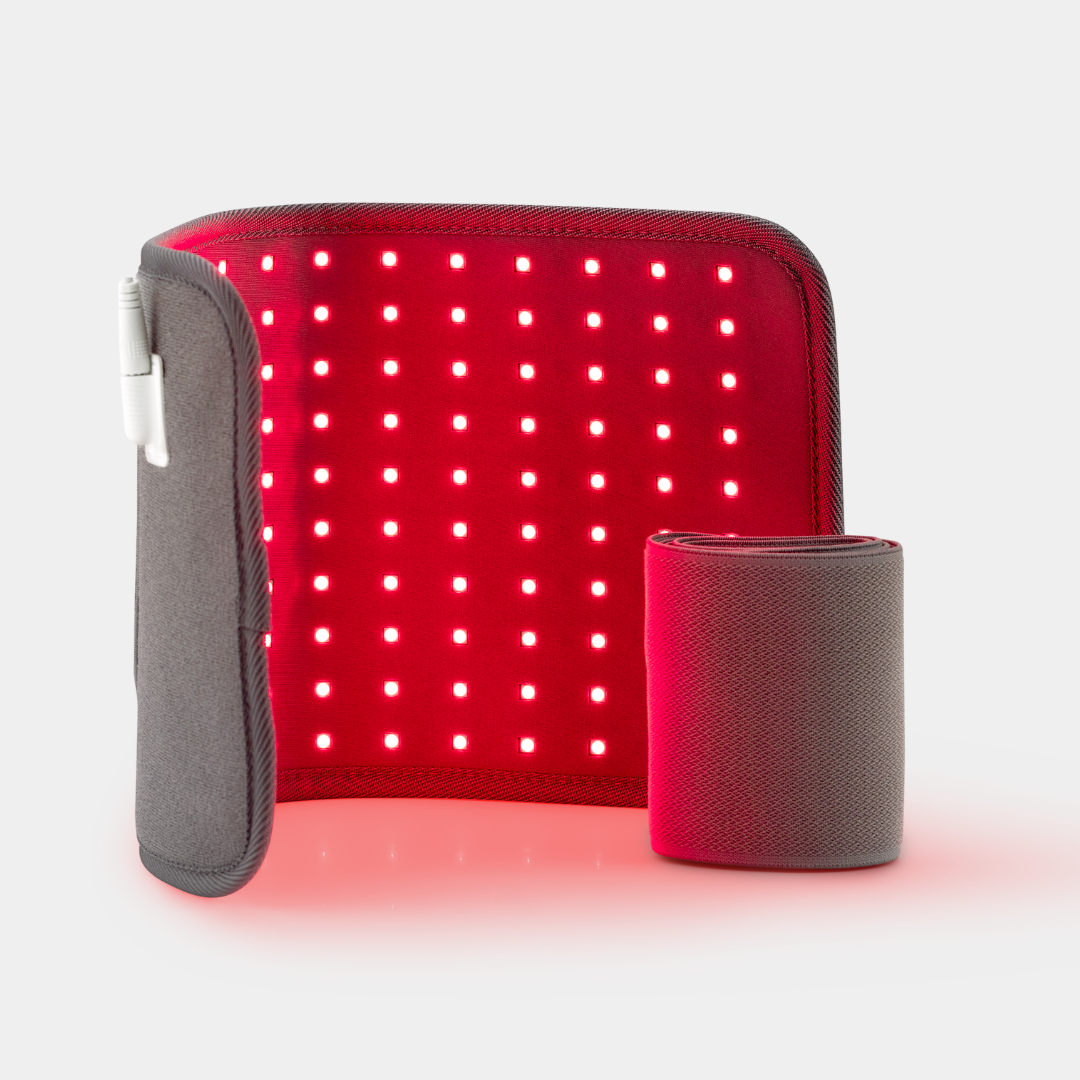

Red light therapy addresses knee pain by restoring energy production in cells affected by osteoarthritis and patellar tendinopathy. The Novaa Knee Ultra uses wavelengths near 660 nm and 830 nm, which joint tissue absorbs through the mitochondrial enzyme cytochrome c oxidase. Photon absorption releases nitric oxide from the enzyme, removing a block on cellular respiration and supporting natural tissue repair.
Photobiomodulation Targets in Knee Articular Cartilage
To understand how we restore the knee's natural, pain-free state, we must look deep inside the joint capsule. Chronic knee osteoarthritis and patellar tendinopathy are not merely mechanical wear-and-tear issues; they are fundamentally driven by mitochondrial dysfunction in chondrocytes (cartilage-producing cells) and synovial fibroblasts. In a compromised joint, these cells lack the energetic resources to repair damage, leading to a state of chronic low-grade inflammation. This lack of energy creates a biological bottleneck, trapping your joint in a state of constant degeneration. Photobiomodulation acts as a precise energy rescue system, targeting these specialized cells to stimulate natural tissue repair.
Mitochondrial Energetics and Cellular Hypoxia Response
At the core of this cellular rescue is Cytochrome c Oxidase (CCO), a critical enzyme within the mitochondrial respiratory chain. When your joint tissues are inflamed, they enter a state of hypoxia (oxygen deprivation), causing CCO to bind with nitric oxide and halt cellular respiration. Photobiomodulation breaks this bottleneck. When coherent light at precise peak wavelengths of ~660 nm and ~830 nm penetrates the tissue, it is selectively absorbed by CCO. This photon absorption dissociates nitric oxide, restoring the mitochondrial membrane potential and dramatically upregulating ATP synthesis via oxidative phosphorylation. This biological shift enhances chondrocyte viability under hypoxic stress, giving your cells the energy required to rebuild the extracellular matrix.
Cytokine Cascade Modulation via ROS Signal Transduction
Beyond immediate energy production, light therapy initiates a precise cascade of cell signaling. The initial absorption of light triggers a transient, non-harmful burst of reactive oxygen species (ROS), such as singlet oxygen. This controlled ROS burst acts as a powerful intracellular signaling molecule, activating both NF-κB and Nrf2 pathways. The result is a profound shift in the joint's biochemical environment: within 24 to 48 hours, the cellular milieu transitions from a highly pro-inflammatory state (dominated by cytokines like IL-1β and TNF-α) to a soothing, anti-inflammatory, and regenerative state dominated by IL-10 and TGF-β (Ivanov et al., 2022). This biological reset is what turns your inflamed joint capsule back into a self-healing sanctuary.
Explore how this mechanism alters chronic inflammation pathways at the source with the NovaaLab system.
Standard Parameters: Wavelength, Energy Density, and Pulse Repetition Rate
Achieving these biological results requires strict adherence to laser physics and dosimetry. Standard LED arrays scatter light across the skin, whereas coherent laser diodes emit focused, parallel light waves that can penetrate dense joint tissue. Our clinical parameters demand an energy density of 4-10 J/cm² delivered directly to the target tissue. Also pulsing the laser at a frequency of 10 Hz has been shown to induce mechanotransduction-like effects, stimulating Ca²⁺-calmodulin signaling in peripatellar tenocytes. This physical stimulation accelerates the remodeling of weak, disorganized collagen type III into resilient, structured collagen type I, physically strengthening the structural integrity of your knee.
Ensure you are using verified coherent laser devices rather than superficial LEDs to guarantee deep tissue penetration. Take control of your recovery today with NovaaLab.
Integration with Physical Therapy Protocols
To maximize the benefits of photobiomodulation, the therapy should be paired with targeted mechanical loading. For example, administering a 15-minute session of red and near-infrared laser therapy immediately prior to performing isometric quadriceps activations or wall sits creates a synergistic effect. The laser-induced ATP surge primes the quadriceps tendon and patellar tissues for active movement, while the mechanical loading guides the newly synthesized collagen fibers along correct functional lines. This combination ensures that the structural repairs match your body's physical demands, cementing long-term joint stability.
Limitations: Skin Absorption, Joint Depth, and Placebo Confounders
A scientifically honest evaluation of joint therapy must address physical limitations. Light must pass through the epidermis, dermis, and subcutaneous fat before reaching the articular cartilage. Darker skin phototypes absorb more light superficially due to melanin concentration, which slightly reduces depth penetration. To overcome these limitations, the therapy utilizes coherent laser diodes rather than scattered LEDs, ensuring that a therapeutic dose of photons successfully reaches the joint space. While placebo effects can influence subjective pain scores in any therapy, the objective, measurable increases in ATP synthesis, collagen expression, and anti-inflammatory cytokine upregulation in clinical studies prove that photobiomodulation's efficacy is grounded in hard, biological science.
Frequently Asked Questions
How often should I use the Novaa Knee Ultra?
For chronic knee pain, we recommend using it for 15 minutes, 1 to 2 times daily. Most users report significant relief within 3 weeks of consistent application, as the cumulative biological benefits of cellular repair begin to manifest.
How does laser therapy differ from standard LEDs for knees?
Laser diodes emit coherent light that penetrates much deeper into dense joint tissues and cartilage compared to standard scattered LEDs. While LEDs are excellent for superficial skin treatments, coherent lasers are required to deliver therapeutic energy densities to deep intra-articular targets.
Is the treatment safe for daily long-term use?
Yes, photobiomodulation is non-thermal and non-invasive, meaning it delivers therapeutic light energy without generating heat that could damage delicate tissue. It represents a perfectly safe, drug-free alternative to chronic NSAID use.
If you are ready to transition your home into a recovery sanctuary and free your knees from chronic pain, experience the difference risk-free:
Pros
- Coherent laser diodes provide deep joint penetration compared to standard LED wraps
- Combines dual therapeutic wavelengths (660nm and 830nm) for target optimization
- Pulsed 10 Hz setting triggers mechanical collagen remodeling cascades
Cons
- Requires consistent daily application for several weeks to achieve cumulative biological benefits
- Premium pricing compared to budget superficial LED-only wraps
Technical Verdict
By pairing coherent red and near-infrared laser light with pulsed 10 Hz frequency, the device effectively bypasses superficial tissue barriers to deliver a therapeutic energy dose directly to the articular cartilage. This scientifically validated cellular stimulation clears mitochondrial bottlenecks and accelerates tissue repair.
→ View Specs & Pricing