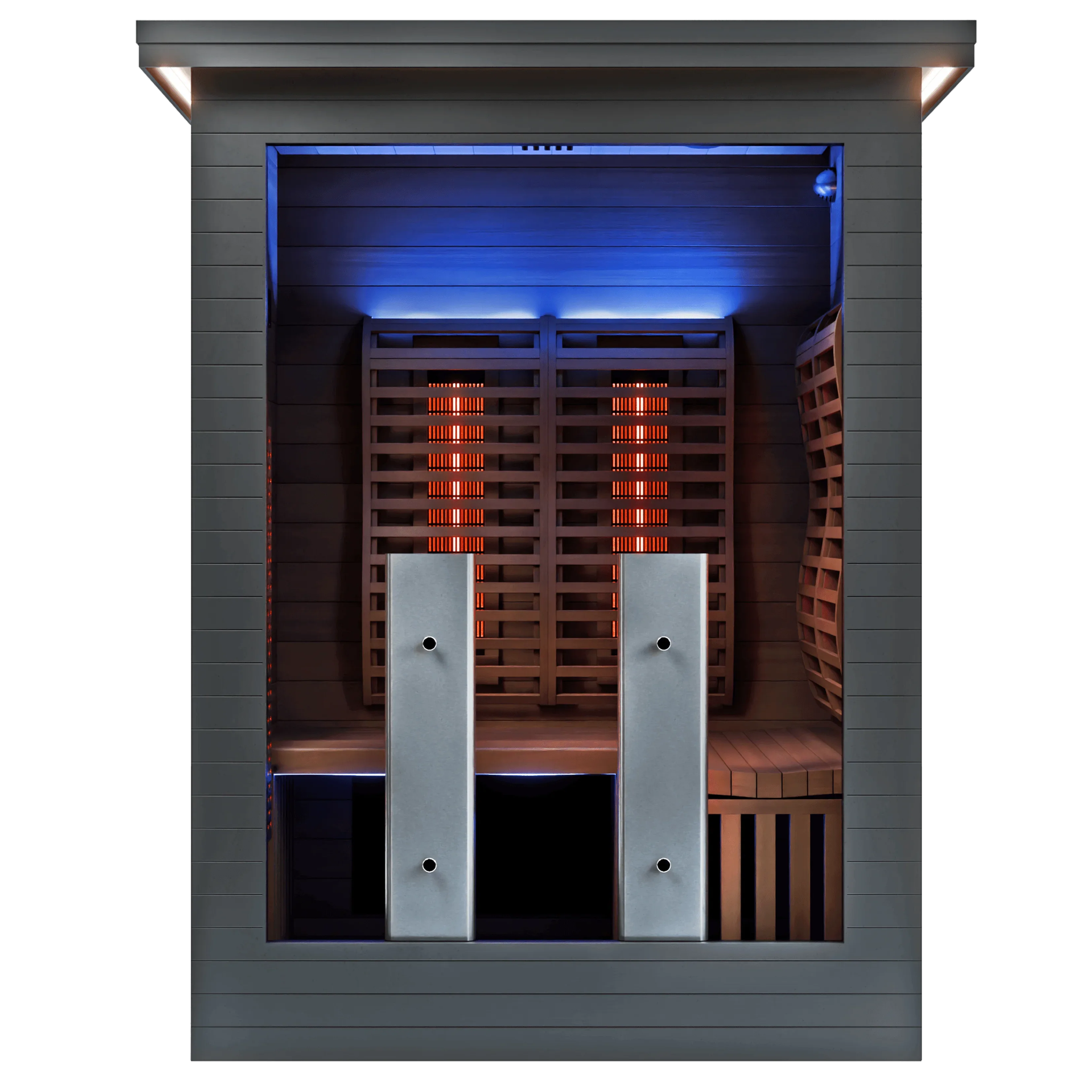
Imagine stepping out of a high-stress day and into your own private backyard sanctuary, a warm, silent retreat where the deeply penetrating heat of an infrared sauna melts physical tension, lowers cortisol, and primes your body for the most restorative sleep of your life. Adding an outdoor sauna is the ultimate lifestyle upgrade, transforming your backyard into a dedicated health and wellness retreat. However, achieving this sanctuary requires looking beyond the exterior woodwork. The real performance, and the true cost, of a high-performance outdoor infrared sauna is determined by the precision of its electrical infrastructure and its ability to deliver the exact wavelengths necessary for deep, cellular rejuvenation. To make a smart, lifetime investment, we must look at the physical and electrical engineering that powers a premium sanctuary like the Sun Home Solstice 4-Person Sauna, ensuring your retreat delivers on its therapeutic promises for decades to come. Sun Home Saunas
Far-Infrared Wavelength Specificity and Skin Absorption Mechanics
The physiological benefits of infrared therapy are directly bound to the physics of light. Under ISO 20473, the infrared spectrum is strictly categorized into Near-Infrared (0.78 to 3.0 μm), Mid-Infrared (3.0 to 50 μm), and Far-Infrared (50 to 1000 μm). In residential wellness applications, the band between 5.0 and 15.0 μm is universally designated as far-infrared (FIR) due to its unique biological interaction with human tissue. Sun Home Saunas
Human skin is composed of approximately 70% water, and liquid water exhibits a powerful vibrational absorption peak near 9.4 μm. When an infrared emitter is precisely engineered to produce peak spectral output at this 9.4 μm wavelength, the energy couples perfectly with the water molecules in the stratum corneum and upper epidermis. This molecular resonance transfers heat directly to the cutaneous layer, achieving a penetration depth of 1 to 2 mm. Rather than simply heating the ambient air, this targeted thermal energy directly triggers a systemic thermoregulatory cascade, increasing nitric oxide production, expanding peripheral blood vessels, and inducing a deep, detoxifying sweat at lower, more comfortable air temperatures.
Electrical Load Calculation: Power Density vs. Heater Quantity
A common marketing misconception is that a higher number of individual heaters translates to a better sauna. In reality, thermal performance is dictated by total power density, measured in Watts per square foot of heater surface area, and total system wattage. According to ASHRAE load calculations, an outdoor sauna operating in variable ambient climates requires a power density of 50 to 100 W/ft² of cabin floor space to reliably reach and sustain therapeutic temperatures.
For a spacious cabin like the Sun Home Solstice 4-Person Sauna, maintaining this thermal equilibrium requires a system rated between 3,000 and 4,500 Watts. Sizing this electrical load requires standard Ohm's Law calculations. A 4,000-Watt system operating on a standard residential 240-Volt line draws exactly 16.67 Amperes of current. Because a sauna is classified as a continuous load (operating for more than three hours under peak demand), the National Electrical Code (NEC) requires a safety margin multiplier of 125%. This raises the required circuit capacity to 20.8 Amperes, dictating a dedicated 30-Amp double-pole circuit breaker and 10 AWG copper conductors to prevent dangerous wire degradation.
NEC Compliance: GFCI Requirements and Outdoor Sub-Panel Sizing
Installing electrical infrastructure outdoors introduces severe environmental variables. To comply with NEC Article 210.8(A), any outdoor hot tub, pool, or sauna installation must be protected by a Class A Ground-Fault Circuit-Interrupter (GFCI). This safety device continuously monitors current balance between the hot and neutral lines, instantly shutting down power if an imbalance as small as 4 to 6 milliamperes is detected.
In practical terms, you will need to install an exterior, weatherproof sub-panel near the sauna site. Running power from your home's main service panel to this sub-panel requires trenching and the installation of Schedule 40 PVC conduit. According to NEC Table 300.5, conduit must be buried at a minimum depth of 18 inches, while direct-burial UF cable must go down at least 24 inches. Depending on the distance of the run and local soil conditions, professional trenching, wire pulling, and sub-panel installation typically represent an additional capital expenditure of $200 to $800, which must be budgeted alongside the sauna purchase.
Cabinetry Material Cost Trade-offs: Western Red Cedar vs. Hemlock Insulation
The structural material of your sauna cabin serves as the thermal barrier between your therapeutic sanctuary and the cold outdoor air. Western Red Cedar (Thuja plicata) is the gold standard for outdoor saunas. Boasting an oven-dry density of approximately 21 lbs/ft³, Cedar provides an exceptional insulation R-value of roughly 1.25 per inch. Also Cedar naturally produces thujaplicins, organic, aromatic compounds that prevent the growth of mold, mildew, and wood-boring insects in damp environments. Sun Home Saunas
In contrast, Canadian Hemlock (Tsuga canadensis) is a denser softwood (~28 lbs/ft³) with a lower R-value of approximately 1.15 per inch. While Hemlock is an excellent, budget-friendly, and hypoallergenic wood for indoor use, its lack of natural decay-resistant oils makes it more susceptible to warping, cracking, and rot when exposed to extreme outdoor moisture cycles. For outdoor longevity and maximum thermal retention, investing in Western Red Cedar substantially lowers long-term operational costs and preserves your sauna's structural integrity.
Installation Cost Breakdown: Concrete Pad vs. Gravel Base Drainage
An outdoor sauna cabin is a massive structural asset. A dry 4-person cabin weighs approximately 800 to 1,000 lbs. When fully occupied by four adults, the total structural load can easily approach 1,600 to 1,800 lbs. Placing this level of concentrated weight directly on raw earth or an unlevel lawn will cause localized soil settling, resulting in frame warping, door misalignment, and cracked tempered glass.
To prevent structural failure, you must construct a level, engineered base. A 4-inch steel-reinforced concrete pad using 4,000 PSI concrete represents the most durable option, costing between $5 and $10 per square foot. Alternatively, a compacted gravel base is a highly effective, cost-efficient, and self-draining solution. This method involves excavating 6 inches of soil, laying down a non-woven geotextile filter fabric, filling the area with crushed gravel (such as 3/4-inch minus stone), and compacting it mechanically. This base costs roughly $3 to $5 per square foot and prevents pooling water around the wood base of your sauna.
Operational Expenditure: FIR Heater Lifespan and Copper Lineal Feet Cost
To accurately project the lifetime cost of ownership, we must analyze operational efficiency and maintenance. Carbon-ceramic hybrid emitters operate at lower, safer surface temperatures than old-fashioned metal rod or pure ceramic heaters. By distributing the infrared energy across a wider surface area, these emitters minimize thermal fatigue, achieving an operational lifespan of 10,000 to 15,000 hours. For the average user enjoying three 45-minute sessions per week, these heaters will last over 60 years.
Also when factoring in electrical costs, a 240V system is highly efficient. Running a 4,000-Watt sauna for one hour at an average national residential utility rate of $0.16 per kilowatt-hour costs only $0.64 per session. While the initial copper wire run (8 AWG or 10 AWG THHN) represents a material cost of $1.50 to $2.50 per lineal foot, the long-term energy savings of a properly insulated, high-voltage system far outweigh the initial copper premium. Investing in professional engineering, premium cabin insulation, and medical-grade far-infrared heaters guarantees that your private sanctuary operates safely, efficiently, and flawlessly for a lifetime.
Pros
- Perfect peak wavelength emission at 9.4 μm for optimal cellular sweat response
- Premium Western Red Cedar cabin provides excellent natural insulation and rot resistance
- Highly efficient 240V design saves on long-term utility costs compared to inefficient 120V models
Cons
- Requires professional electrical installation of a dedicated 240V circuit
- Higher initial investment compared to low-quality, indoor-only hemlock saunas
Technical Verdict
When choosing an outdoor sauna, cutting corners on electrical infrastructure or wood quality will ultimately compromise both safety and therapeutic efficacy. Sizing a dedicated 240V circuit with professional GFCI protection ensures your emitters constantly deliver the target 9.4 μm wavelength for true cellular detoxification. Choosing a premium, highly insulated cedar cabin like the Sun Home Solstice guarantees lifetime durability, making it the most cost-effective and physically restorative investment you can make for your home.
→ View Specs & Pricing