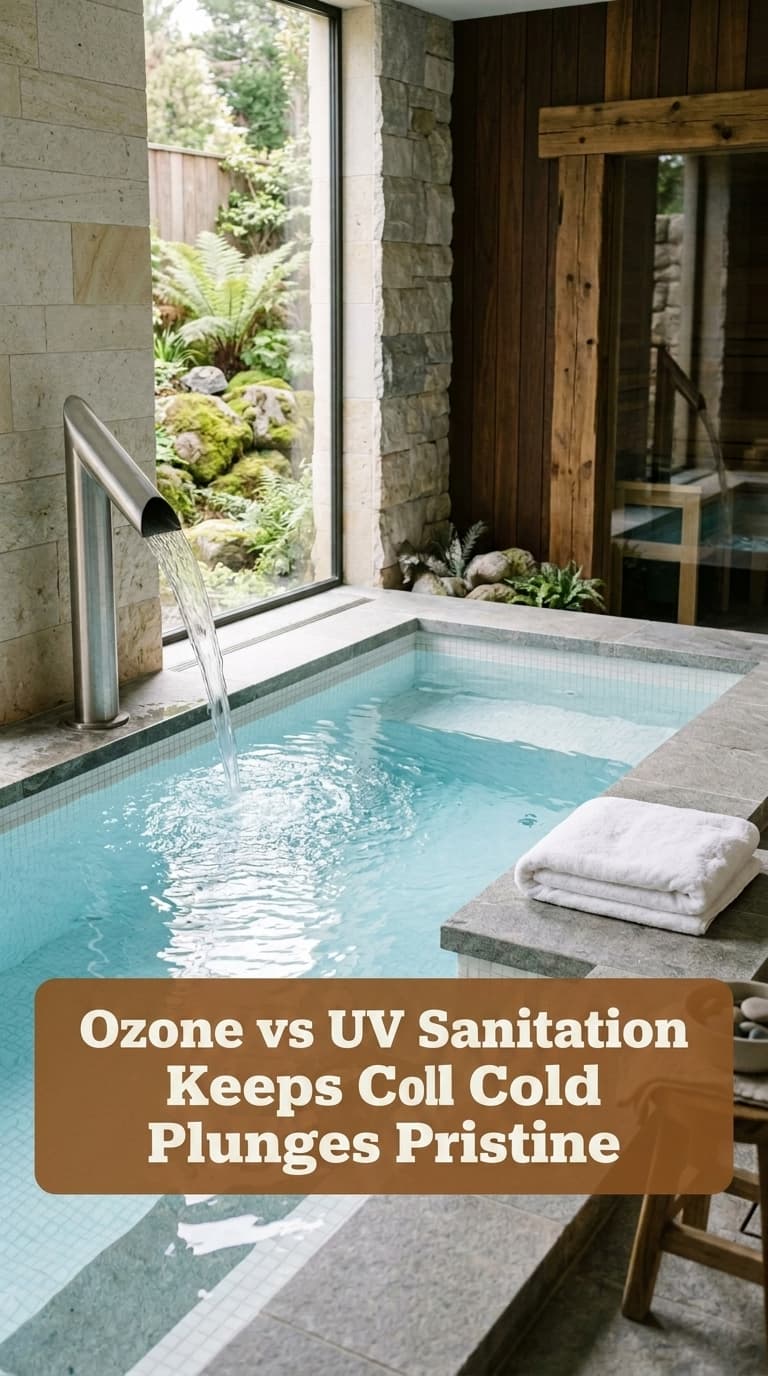
Imagine stepping into a private sanctuary of ice-cold water at dawn. The crisp, clean chill immediately quietens your mind, triggering an instantaneous release of norepinephrine that sweeps away stress, sharpens your focus, and prepares you to conquer the day. This is the ultimate physical reset—a home sanctuary designed to elevate your sleep, recovery, and cellular health. Yet, the profound peace of this daily ritual is entirely contingent on one invisible variable: water purity. To truly surrender to the cold, you must have absolute confidence that your recovery water is biologically pristine. To achieve this medical-grade purity without harsh chemical odors or skin-irritating residues, modern engineering relies on two powerful physical forces: Ozone (O₃) oxidation and UV-C sterilization. Selecting the optimal system requires moving beyond marketing buzzwords to understand the precise molecular mechanisms that keep luxury systems like the Sun Home Cold Plunge Pro Apex continuously self-cleaning and biologically safe. [AFFILIATE:plunge:sun-home-cold-plunge-pro-apex:inline]
Ozone Mass Transfer and Oxidation Mechanics
Ozone (O₃) is a triatomic allotrope of oxygen with an exceptionally high standard reduction potential of E° = 2.07 V, making it one of the most powerful oxidizers available for water treatment. When injected into a chilled cold plunge, ozone works via direct and indirect oxidation pathways. It aggressively lyses bacterial cell walls by attacking the double bonds of lipids in the cell membrane (lipid peroxidation) and irreversibly denaturing crucial intracellular proteins, such as FtsZ division proteins.
However, the primary challenge of ozone in cold water is mass transfer efficiency. In a cold plunge, ozone must be dissolved into water using a venturi injector or micro-bubble diffuser. While colder water naturally holds dissolved gases better than warm water—allowing dissolved ozone to remain stable longer—the ozone generator must be precisely sized. Under-sizing results in incomplete sanitation, while over-sizing can lead to excess off-gassing. Furthermore, under NSF/ANSI 61 guidelines, materials and source water must be monitored because ozone can oxidize naturally occurring bromide (Br⁻) in municipal source water into bromate (BrO₃⁻), a regulated carcinogen, if ozone levels are not carefully managed.
UV-C Photodimerization and Flow Dynamics
In contrast to chemical oxidation, UV-C sanitation operates via electromagnetic radiation, specifically targeting the 254 nm wavelength. This exact band of ultraviolet light penetrates the cell walls of microorganisms and is absorbed by their nucleic acids. The absorbed energy causes a chemical reaction that dimerizes adjacent thymine bases in microbial DNA, predominantly forming cyclobutane pyrimidine dimers (CPDs). This molecular cross-linking renders the pathogen's DNA unreadable, preventing replication and effectively neutralizing the organism without adding any chemicals to the water.
The critical limitation of UV-C is that it provides zero residual disinfectant. It is a strictly point-of-contact technology; sanitation only occurs when water directly passes through the quartz sleeve of the UV chamber. For UV-C to be effective, the system must meet NSF/ANSI 55 Class A standards, which require a minimum UV dose of 40 mJ/cm². Efficacy is highly dependent on water clarity (turbidity < 1 NTU). Suspended organic matter or mineral scaling on the quartz sleeve will scatter or block the light, creating 'shadow zones' where pathogens can slip through unaffected.
Off-Gassing Safety and Room Monitoring Rules
While ozone is an exceptional sanitizing agent inside the plumbing of your cold plunge, gaseous ozone in the ambient air is a powerful pulmonary irritant. The Occupational Safety and Health Administration (OSHA) sets the Permissible Exposure Limit (PEL) for ozone in the workplace at 0.1 ppm (parts per million) over an 8-hour time-weighted average. For home cold plunges installed in enclosed spaces—such as a home gym, basement, or master bath—managing ozone off-gassing is an absolute safety priority.
High-end cold plunges address this by integrating a catalytic ozone destruct chamber. As ozone-saturated water returns to the tub, any undissolved gaseous ozone is directed through a manganese dioxide or activated carbon catalyst, which instantly reduces O₃ back to stable oxygen (O₂). When purchasing an ozone-equipped plunge, ensuring it utilizes an automated degas/destruct loop is vital for preventing respiratory irritation and keeping your indoor air quality pristine.
Material Compatibility and Oxidative Attack
Ozone’s high oxidation potential does not discriminate between biological pathogens and the physical materials holding your cold plunge together. Over time, ozone will aggressively attack and degrade certain polymers, causing them to crack, harden, and ultimately fail. Standard plastics and rubbers used in budget hot tubs or ice baths are highly susceptible to this oxidative degradation.
Materials like EPDM (ethylene propylene diene monomer) and natural rubber gaskets will disintegrate rapidly under continuous ozone exposure. For long-term reliability, a professional-grade cold plunge must utilize ozone-resistant components. Viton (FKM), silicone, high-density polyethylene (HDPE), and high-grade 316L stainless steel are highly resistant to ozone degradation. When investing in a premium cold plunge, verifying that all internal gaskets, manifolds, and pump seals are constructed of these elite, non-corrosive materials is essential to prevent catastrophic leaks. [AFFILIATE:plunge:sun-home-cold-plunge-pro-apex:inline]
The Ultimate Sanitization: Hybrid System Synergy
Because both ozone and UV-C have unique operational strengths and structural limitations, the gold standard of cold plunge sanitation is a hybrid system that leverages both technologies simultaneously. In a hybrid setup, ozone acts as the primary oxidizer, continuously attacking dissolved organic carbon (TOC), sweat, skin oils, and biofilms throughout the tub basin and plumbing. Meanwhile, the UV-C chamber acts as a polishing filter, destroying any ozone-resistant pathogens and instantly neutralizing any remaining dissolved ozone before the water enters the bathing area.
This synergistic pairing creates an exceptionally safe loop. Ozone oxidizes the organic micro-contaminants that would otherwise cloud the water and block UV light, while the UV-C light breaks down excess ozone molecules, preventing skin and eye irritation. If you want the absolute pinnacle of water clarity, biological safety, and maintenance-free luxury, investing in a dual-sanitization, commercial-grade system is the only logical choice. [AFFILIATE:plunge:sun-home-cold-plunge-pro-apex:cta-button]
Pros
- Dual ozone and UV-C loop ensures comprehensive sanitation and biofilm prevention.
- Powerful 1.0 HP chiller rapidly pulls temperatures down to therapeutic levels.
- Premium, ozone-resistant stainless steel and silicone plumbing prevent component degradation.
Cons
- Higher initial financial investment compared to basic manual ice tubs.
- Requires periodic filter cartridge replacements to maintain peak flow rates.
Technical Verdict
For an elite home sanctuary, a dual-sanitation system combining ozone mass-transfer with UV-C photodimerization is mathematically and biologically superior. The Sun Home Cold Plunge Pro Apex integrates these industrial-grade systems into a seamless, high-performance package that protects both your physical health and your long-term investment.
→ View Specs & Pricing