RBM3 and CIRBP support synaptic repair by preserving the molecular instructions for synaptic scaffolding and reducing neuroinflammation. Skin temperatures below about 25°C activate TRPM8 channels on sensory neurons, starting the calcium-dependent cascade that increases both proteins. Consistent cold exposure at 10–15°C induces this response and strengthens its neuroprotective benefit over time.
TRPM8 Signaling and the Cold-Responsive Transcriptome
TRPM8 is a non-selective cation channel expressed on a subset of Aδ and C-fiber sensory neurons. Its activation threshold sits around 26°C, with peak open probability between 8°C and 22°C. When cutaneous receptors detect water below this threshold, Ca²⁺ influx activates calcium/calmodulin-dependent protein kinase IV (CaMKIV), which phosphorylates the cAMP response element-binding protein (CREB) at Ser133. Phospho-CREB translocates to the nucleus and binds CRE motifs upstream of Rbm3 and Cirbp, driving their transcription within 2–4 hours of stimulus onset (Schmitt et al., J Biol Chem 2014).
Here is the insight that separates a precision wellness sanctuary from a cold shower: this is a temperature-gated response, not a stress-gated one. Hyperventilation, adrenergic surge, or psychological discomfort do not, in isolation, induce RBM3. The thermal stimulus itself, specifically receptor-level cold detection held at a precise temperature, is the rate-limiting input. This is why lukewarm contrast showers feel refreshing but deliver none of the neuroprotective payload. Your sanctuary needs to be cold enough, and stay cold enough, to matter. That is the engineering problem the Sun Home Cold Plunge™ Pro was built to solve.
RBM3-Mediated mRNA Stabilization for Synaptic Repair
RBM3 binds the 3' untranslated regions (UTRs) of mRNAs encoding postsynaptic density protein 95 (PSD-95), synaptophysin, and SNAP-25. By recruiting these transcripts to translation-competent polysomes and protecting them from nonsense-mediated decay, RBM3 increases the steady-state pool of synaptic building blocks during a window when neurons are actively remodeling.
In the seminal Peretti et al. (Nature 2015) study, hippocampal RBM3 induction via systemic cooling rescued synapse number in mouse models of prion disease and Alzheimer's pathology. RBM3 knockout abolished the protective effect, establishing causality, not correlation. Ducray et al. (Mol Neurobiol 2021) extended this to non-anesthetic cold-water immersion, reporting a ~35% elevation in hippocampal BDNF and measurable increases in CA1 dendritic spine density after just 6 weeks of 10°C exposure, 3 sessions per week, 10 minutes per session. Six weeks. Three times a week. Ten minutes. That is a remarkably low time investment for a neurological return of that magnitude, and it becomes accessible the moment a precision cold plunge is installed in your home.
CIRBP as a Brake on Neuroinflammatory Cascades
If RBM3 is the construction crew rebuilding your synapses, CIRBP is the security system keeping the neighborhood safe. Zhu et al. (Cell Rep 2016) demonstrated that CIRBP binds the 3' UTR of Nlrp3 transcripts and modulates their translation in microglia, attenuating the priming step of inflammasome assembly. Downstream, this reduces caspase-1 cleavage of pro-IL-1β and limits TNF-α release.
The lifestyle implication is profound: chronic low-grade neuroinflammation, driven largely by NLRP3-active microglia, accelerates tau hyperphosphorylation and amyloid-β aggregation, two hallmarks of cognitive decline. CIRBP induction provides a non-pharmacological lever to dampen this cascade from the comfort of your own home. CIRBP follows similar kinetics to RBM3, peak protein expression occurs 6–12 hours post-exposure and decays over 48–72 hours, which informs the optimal session frequency. Think of each plunge session as resetting a 48-to-72-hour protective timer inside your brain. The ritual becomes not just a morning luxury, but a scheduled act of long-term cognitive self-investment.
Acute vs. Habitual Cold Exposure: Divergent Transcriptional Profiles
The first time you step into your home cold plunge, you are buying a single neuroprotective event. By week four, you are buying a permanently upgraded brain baseline, and that is where the real return on investment lives.
A single cold exposure produces a transient RBM3/CIRBP spike with full decay by 72 hours. Habitual exposure (≥4 weeks, ≥2x/week) shifts the baseline: resting RBM3 levels in habituated subjects sit measurably higher than in cold-naive controls, and the induction curve becomes steeper, faster onset, higher peak. This is not unlike compound interest: the earlier you establish the habit and the more consistently you maintain it, the greater the cumulative neurological dividend.
Habitual exposure also reveals a meaningful quality-of-life upgrade: the acute noradrenergic surge (200–500% plasma norepinephrine elevation) that makes early sessions feel intense largely disappears as you habituate, suggesting the cold-shock protein pathway and the catecholamine pathway operate semi-independently. What remains after habituation is a calmer, more sustainable practice: a few quiet minutes in your private sanctuary each morning, delivering measurable synaptic-stabilizing effects without the dramatic physiological shock of the first few sessions. This is the lifestyle upgrade that a quality home cold plunge makes possible.
Precision Temperature Control: Why ±1°F Matters
This is where the science becomes a purchasing argument, and it is one worth understanding clearly before you decide between a chest freezer conversion and a purpose-built system.
The TRPM8 dose-response curve is steep between 10°C and 18°C. A bath drifting from 12°C to 17°C over a 10-minute session delivers materially less TRPM8 activation than one held at 12°C ± 0.5°C. Bag-of-ice protocols routinely exhibit 4–6°F drift within a single session as the ice mass equilibrates, producing inconsistent transcriptional outputs across sessions and undermining the habit you are trying to build. You are not just paying for cold water. You are paying for reproducible cold water, session after session, without hauling ice, without guessing, and without sacrificing the serenity of your morning ritual to thermometer-watching.
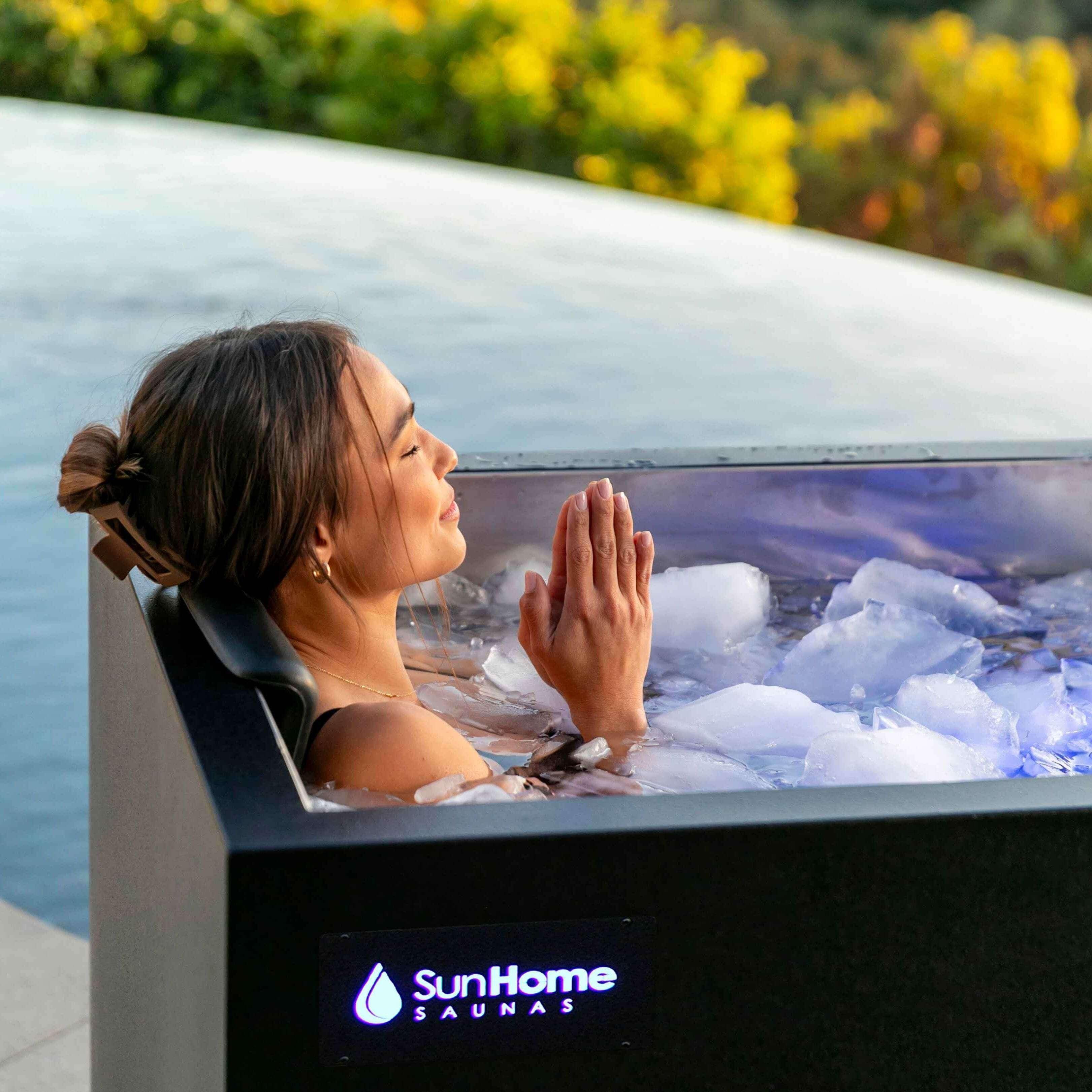
The Sun Home Cold Plunge™ Smart-Chiller maintains programmable setpoints down to 32°F with active feedback control, eliminating ice-melt drift entirely. For cold-shock protein induction specifically, holding 39–50°F (3.9–10°C) ensures the thermal gradient at the skin surface remains within the TRPM8 high-activation window for the entire session duration, not just the first three minutes. When you break down the cost over a lifetime warranty, the math becomes straightforward: this is the last cold plunge you will ever buy, and it will do its job correctly every single time.
Optimizing the Cold Exposure Protocol
Your sanctuary, your schedule. Here is the science-backed protocol that makes each session count:
- Temperature: 10–12°C (50–54°F) for naive users; 4–7°C (39–45°F) for habituated users targeting maximal RBM3 induction.
- Duration: 8–11 minutes. Below 5 minutes, CREB phosphorylation is unreliable; above 15 minutes, diminishing returns and rising hypothermia risk.
- Frequency: 2–3 sessions per week, spaced ≥36 hours apart to align with the CIRBP/RBM3 protein half-life.
- Immersion depth: Shoulders submerged. Cold-receptor density on the torso and limbs drives the integrated TRPM8 signal; partial immersion under-doses the response.
There is one often-overlooked factor that determines whether users actually hit the 8–11 minute RBM3-effective window consistently: ergonomics. An awkward, slippery entry triggers an unnecessary cardiovascular spike and cuts sessions short. The Cold Plunge Pro Platform provides an insulated, non-slip stepping surface that transforms entry into a composed, controlled ritual, making it far easier to settle in, stay calm, and remain submerged for the full therapeutic duration. Your sanctuary should feel like a sanctuary from the moment you step in.
Interindividual Variability: Age, Baseline RBM3, and Dose-Response
One of the most compelling, and perhaps counterintuitive, findings in the cold-shock protein literature is this: the people who arguably stand to benefit most from a home cold plunge are those over 50.
RBM3 expression declines with age in both humans and rodents, which partially explains why elderly populations show accelerated synaptic loss. Paradoxically, this also means older subjects have greater headroom for induction, the baseline is lower, so the relative gain from cold-shock protein upregulation is proportionally larger. The caveat is equally important: cardiovascular screening is non-negotiable for users over 60 or with hypertension, given the cold-pressor blood pressure response (typically +20–40 mmHg systolic in the first 60 seconds). This is not a reason to avoid cold exposure, it is a reason to begin it thoughtfully, with a system that gives you precise temperature control so you can start conservatively and titrate up safely.
Genetic polymorphisms in TRPM8 (notably rs17862920) also modulate channel sensitivity, contributing to well-documented variation in subjective cold tolerance. Until point-of-care genotyping is mainstream, tracking sleep quality, cognitive performance (e.g., n-back tasks), and HRV over a 6-week titration period provides a reasonable proxy for whether your protocol is producing the expected CNS adaptations. Your home cold plunge is not just a piece of equipment, it is the cornerstone of a measurable, personalized longevity practice.
Pros
- Active chiller eliminates ice-melt temperature drift, ensuring consistent TRPM8 dosing across sessions, so your investment compounds neurologically over time, not just financially.
- Sub-32°F capability supports advanced protocols targeting maximal cold-shock protein induction for habituated users seeking peak neuroprotective output.
- 316 stainless steel and integrated foam insulation maintain temperature with minimal duty cycle, keeping ongoing energy costs lower than you might expect from a premium system.
- Three-stage sanitization (ozone + UV + filtration) means your sanctuary stays pristine between sessions, no ice-hauling, no chemistry guesswork, no maintenance dread.
Cons
- Capital cost is substantially higher than chest-freezer conversions or stock-tank setups, though financing from $199/month and a lifetime warranty reframe this as a long-term wellness infrastructure investment rather than a one-time purchase.
- 1HP compressor and 120V/12A draw require dedicated circuit planning in some homes, a one-time setup consideration that your electrician can typically resolve in a single visit.
- Interior length of 47.4" may not accommodate users above ~6'2" in a fully extended posture, worth verifying against your height before purchasing.
FAQs
How long does it take to see benefits from cold exposure for cold-shock proteins?
You may experience acute benefits like improved alertness immediately, but structural changes like increased dendritic spine density require about 6 weeks of consistent sessions at 10–12°C, three times per week.
Is cold exposure safe for older adults?
Yes, but cardiovascular screening is recommended for those over 60 or with hypertension. Start with higher temperatures and shorter durations, and use a precise chiller to maintain control.
Can I get cold-shock protein benefits from a cold shower?
Cold showers typically do not maintain skin temperature in the TRPM8 high-activation window long enough to reliably induce RBM3 and CIRBP. Purpose-built cold plunges with active cooling are more effective.
Related Reading
Pros
- Active chiller eliminates ice-melt temperature drift, ensuring consistent TRPM8 dosing across sessions, so your investment compounds neurologically over time, not just financially.
- Sub-32°F capability supports advanced protocols targeting maximal cold-shock protein induction for habituated users seeking peak neuroprotective output.
- 316 stainless steel and integrated foam insulation maintain temperature with minimal duty cycle, keeping ongoing energy costs lower than you might expect from a premium system.
- Three-stage sanitization (ozone + UV + filtration) means your sanctuary stays pristine between sessions, no ice-hauling, no chemistry guesswork, no maintenance dread.
Cons
- Capital cost is substantially higher than chest-freezer conversions or stock-tank setups, though financing from $199/month and a lifetime warranty reframe this as a long-term wellness infrastructure investment rather than a one-time purchase.
- 1HP compressor and 120V/12A draw require dedicated circuit planning in some homes, a one-time setup consideration that your electrician can typically resolve in a single visit.
- Interior length of 47.4" may not accommodate users above ~6'2" in a fully extended posture, worth verifying against your height before purchasing.
Technical Verdict
Cold-shock protein induction is a temperature-gated transcriptional event with a narrow, well-defined dose window, and that makes thermal precision the single most important specification of any home cold plunge system. The Sun Home Cold Plunge™ Pro holds 4–10°C with sub-1°F drift across the full session duration, transforming cold exposure from an inconsistent DIY ritual into a reproducible, at-home CNS intervention. Combine that engineering precision with flexible financing from $199/month, a lifetime warranty, and a risk-reversal guarantee, and the value proposition becomes clear: this is not a luxury purchase. It is the infrastructure for a measurable, science-backed longevity practice, installed in your home, on your schedule, for the rest of your life.
→ View Specs, Financing & Risk-Free Trial