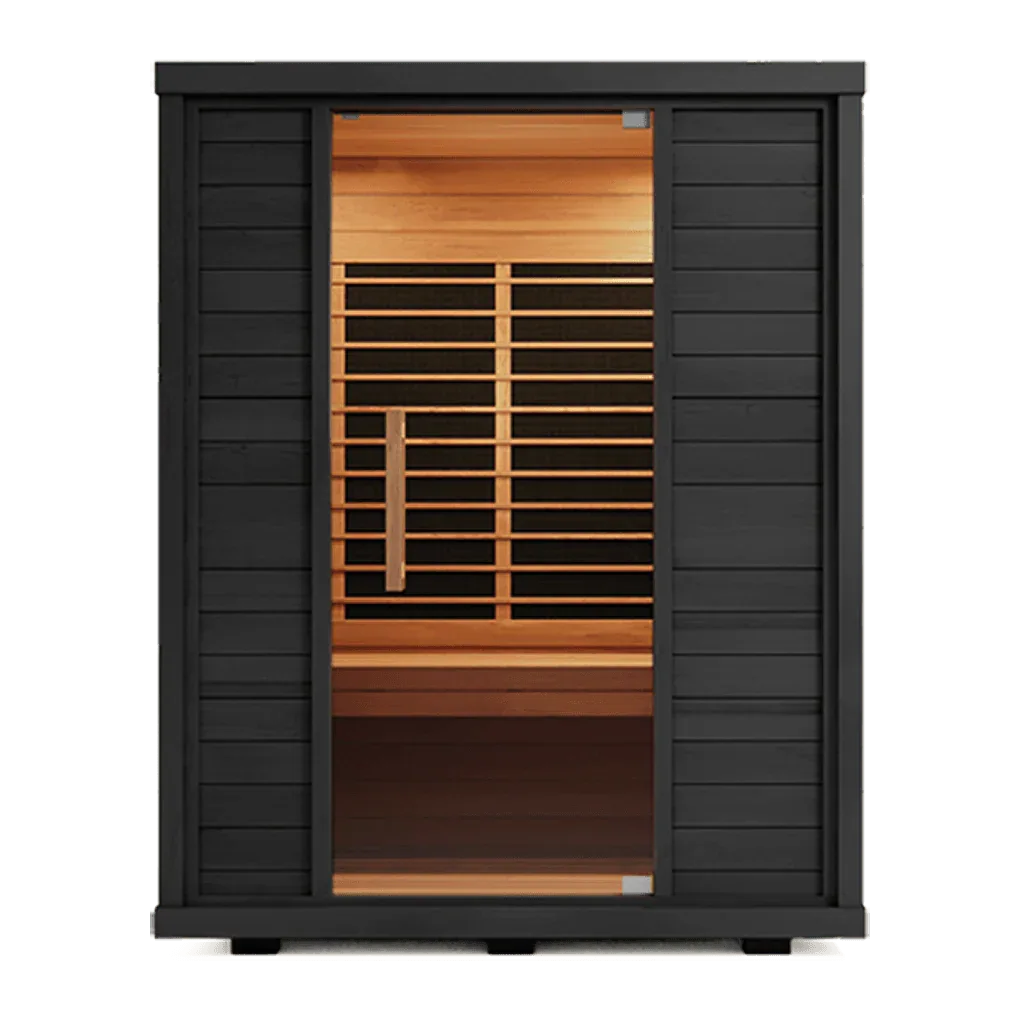
High sauna humidity weakens heat-stress benefits by disrupting sweat evaporation and the controlled rise in core temperature. Infrared saunas work best at 10–15% relative humidity, while traditional saunas need 50–65%. Because perceived heat does not reliably measure physiological stress, use a hygrometer with at least ±2% accuracy to confirm the cabin remains within its therapeutic range.
The Pouring-Water Paradox
Ask any sauna enthusiast why they ladle water onto the rocks and they will tell you it 'intensifies the heat.' They are not wrong about the sensation, but they are wrong about the physiology, and that distinction matters enormously.
When water hits a 80–90 °C kiuas, it flash-vaporizes into steam and rapidly improves the cabin's relative humidity (RH). Your skin interprets the sudden vapor burst as a wave of heat because moist air transfers thermal energy to skin surface receptors faster than dry air at the same dry-bulb temperature. The sensation is real. The underlying mechanism, however, is working against your core goals.
Sweat evaporation, your body's primary cutaneous heat-dissipation pathway, obeys a psychrometric law rooted in vapor pressure gradient (ΔP). The rate of evaporation is proportional to the difference between the partial pressure of water vapor at the skin surface and the partial pressure of water vapor in the surrounding air. In a traditional sauna running at 80 °C with RH near 10%, ΔP is large; sweat evaporates rapidly, core temperature (Tc) climbs steadily, and your thermoregulatory system is under genuine, productive strain. Push RH above 70% and ΔP collapses toward zero. Evaporation stalls. The body can no longer shed heat efficiently through the skin, so it redirects blood flow and core temperature plateaus rather than continuing its controlled ascent.
For most users, that plateau feels more intense, steam sessions feel hotter. But perceived intensity and actual core temperature are not the same metric, and it is core temperature rise (ΔTc) that drives the hormetic cascade you are chasing.
HSP70 and Why ΔTc Is the Whole Game
Heat shock protein 70 (HSP70) is often described as the body's internal repair crew. Under sufficient thermal stress, heat shock factor 1 (HSF1), a transcription factor held in cytoplasmic complex under resting conditions, dissociates, trimerizes, translocates to the nucleus, and binds heat shock elements on the HSP70 gene promoter. The result is a rapid upregulation of HSP70 expression, which assists in refolding misfolded proteins, suppressing inflammatory signaling cascades, and supporting cardiovascular adaptation.
The critical upstream variable is ΔTc: the magnitude and rate of core temperature rise. Published research in Cell Stress & Chaperones and related journals consistently shows that HSF1 activation is temperature-threshold dependent; the molecular trigger requires sustained intracellular temperatures above approximately 40–41 °C. That threshold is achievable in a well-managed sauna, but it requires unimpeded evaporative cooling so that the thermoregulatory system continues driving blood to the periphery and demanding more cardiac output, not stalling in a high-humidity equilibrium.
When RH in a traditional sauna exceeds 70%, the blunted ΔTc means the thermal stimulus for HSF1 dissociation is weaker and shorter-lived. Preliminary data from heat stress physiology literature suggests HSP70 upregulation may be meaningfully reduced under conditions that impair core temperature rise, though the exact magnitude is difficult to isolate in human subjects and should be considered suggestive rather than definitively quantified. The mechanism, however, is well-established: less ΔTc means a weaker HSF1 signal.
For infrared sauna users, the humidity calculus is even more sensitive. Because far-infrared energy acts primarily through direct tissue absorption rather than convective air heating, the ambient air temperature is lower (typically 50–60 °C versus 80–100 °C in traditional). At these temperatures, even modest RH elevation, above roughly 20%, is sufficient to impair the already-narrower ΔP gradient. The optimal window for infrared is 10–15% RH; for traditional saunas, 50–65% RH allows enough humidity for comfort and some steam ritual while preserving adequate ΔP for evaporative cooling.
Sauna Humidity Levels, the ±2% Accuracy Standard, and Why It Matters
Most sauna accessories are decorative at best. A wooden thermometer looks the part; it does not help you titrate a hormetic dose. Humidity management requires a calibrated instrument, and calibration has a tolerance.
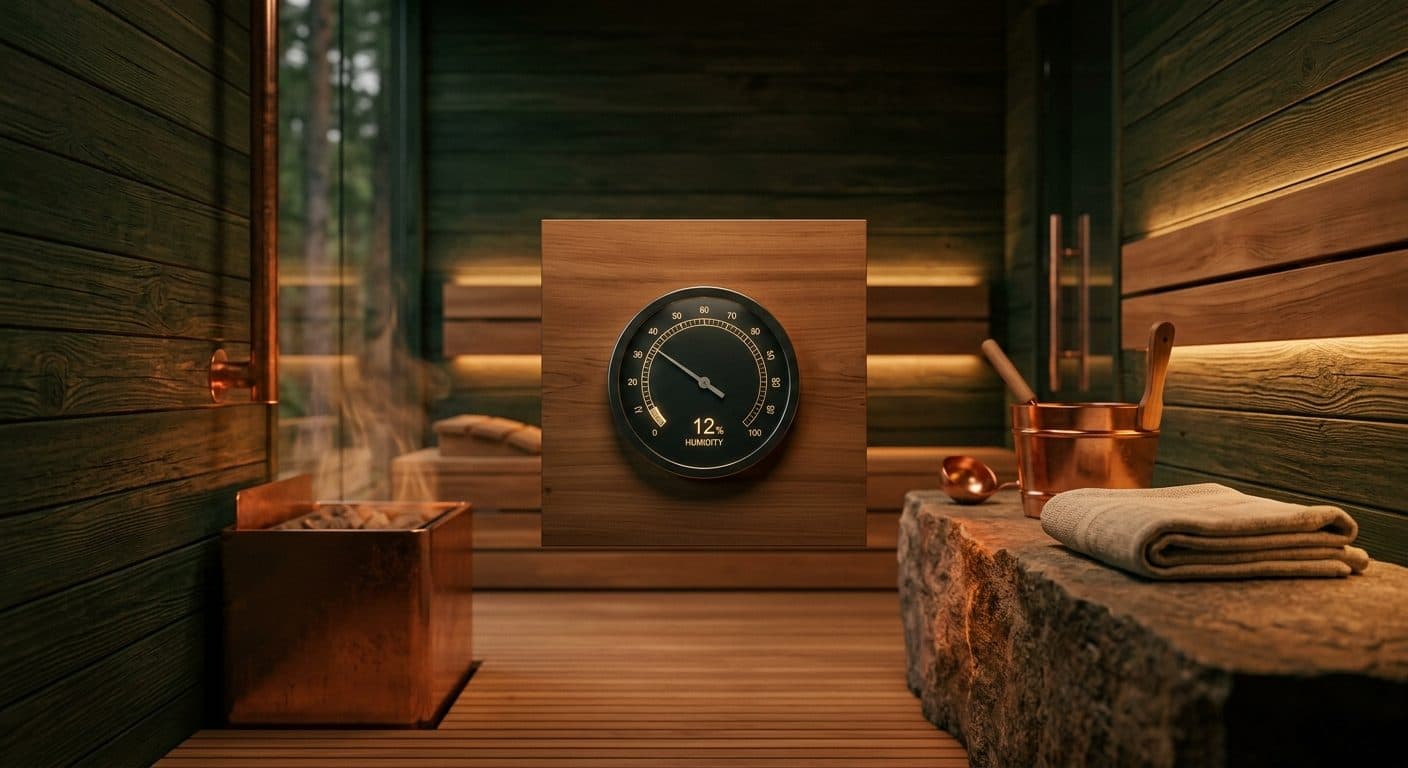
The Saunalife Hygrometer operates to ±2% RH accuracy across the sauna-relevant range. To understand why that specification matters, consider the target windows: 10–15% RH for infrared, 50–65% for traditional. Those are 5-point and 15-point windows respectively. A sensor with ±5% accuracy could read 15% when actual RH is 20%, placing an infrared session silently outside the optimal zone. A ±2% instrument ensures that when the dial reads 12%, actual conditions are 10–14%: you are operating within the therapeutic window with high confidence.
The hygrometer's Scandinavian dial design is not merely aesthetic. The large, high-contrast face is readable through steam and low-light conditions without requiring you to step close to the wall or break the meditative state of your session. It mounts at bench level, the microclimate you actually inhabit, rather than near the ceiling where temperature and humidity stratify significantly in both sauna types.
At $45, this instrument occupies an interesting economic position: it is the lowest-cost intervention you can make to a sauna setup, yet it governs the single most impactful physiological variable in every session you will ever take in that room.
Building Your Sanctuary Protocol
Owning a hygrometer transforms your sauna from a passive amenity into an active health tool, but only if you pair it with a repeatable session protocol.
For traditional sauna users: Preheat to your target dry-bulb temperature (typically 80–90 °C) with the door closed and no water on the rocks. Allow at least 30 minutes for the stones to achieve thermal saturation. Before entering, check the hygrometer. If RH is above 65%, ventilate briefly. Once inside, you can pour a small ladle every 8–10 minutes to modulate comfort, but watch the dial. The moment RH trends toward 70%, pause the löyly ritual and let the heater recover. Your goal is a productive, sustained ΔTc, not a single dramatic steam burst.
For infrared sauna users: Your target is 10–15% RH. Because infrared cabins are sealed, even a single glass of sweat on the bench can elevate RH meaningfully over a 30-minute session. Monitor the dial at the 15-minute mark. If RH approaches 20%, crack the door for 60–90 seconds to re-establish the vapor pressure gradient. Some infrared users place a small towel under the bench to absorb pooled sweat and prevent re-evaporation.
Session structure (both modalities):
- Round 1 (12–15 min): Acclimatization. Monitor RH and Tc trajectory.
- Cool-down (5 min): Cold shower or cool room. This thermal contrast phase amplifies norepinephrine release independently of the heat phase.
- Round 2 (10–15 min): Peak hormetic load. Keep RH in target window.
- Recovery (10+ min): Horizontal rest. This is when HSP70 mRNA expression is actively accumulating.
The protocol is simple. The discipline to follow it consistently, session after session, is what separates a sauna owner from a sauna practitioner. A $45 instrument that keeps you honest is perhaps the best return on investment in your entire wellness stack.
The Myth of More Is Better
The cultural mythology of sauna is built around extremes: hotter, steamier, longer, but this instinct works against the physiology of heat adaptation. Finnish löyly tradition celebrates the drama of the pour. Russian banya culture prizes the dense steam cloud. These traditions encode genuine wisdom about ritual and community, but they were not designed around the molecular biology of HSF1 activation.
The hormetic model of health, the idea that controlled doses of stress produce adaptive responses that leave the system stronger, has a fundamental feature: dose-response curves are not linear. Below a threshold, there is no meaningful stimulus. Above a ceiling, the stress becomes maladaptive. Humidity is exactly this kind of variable. Too little (near 0% in a traditional sauna) produces excessive dryness, irritates mucous membranes, and can cause the session to become uncomfortable before ΔTc reaches therapeutic levels. Too much collapses ΔP, stalls evaporation, plateaus ΔTc, and blunts the hormetic signal you are there to generate.
The optimal range is a narrow band, and you cannot find or maintain it by feel alone. Perceived heat intensity is a notoriously unreliable proxy for core temperature trajectory, especially as heat acclimatization develops over weeks of regular sauna use. Acclimatized users tolerate higher apparent temperatures with lower core temperature responses, their cardiovascular systems have adapted. That adaptation is beneficial, but it also means experienced sauna users are more likely to misjudge session intensity without instrumentation, not less.
Precision is not the enemy of ritual. You can still pour water on the rocks. You can still close your eyes and let the heat work. You simply do it with one eye on a dial that tells you whether the physics of evaporation are working for you or against you.
Pros
- ±2% RH accuracy is tight enough to confirm you are operating within the narrow 10–15% (infrared) or 50–65% (traditional) therapeutic windows, not merely near them.
- Analog dial format requires no power source, has no software to fail, and is readable through steam and low-light sauna conditions without disrupting session focus.
- At $45, the instrument costs less than a single premium wellness class and governs the single most impactful physiological variable in every sauna session for years.
- Scandinavian aesthetic integrates cleanly into high-end cedar sauna interiors without the visual clutter of a digital device.
Cons
- Analog instruments require periodic calibration verification; the product page does not specify a recommended recalibration interval or whether a calibration certificate is included.
- A single hygrometer provides a point measurement, users with large or multi-bench saunas may need two units to characterize humidity stratification across different seating zones.
FAQs
What are the ideal sauna humidity levels for a traditional sauna? For a traditional sauna operating at 80–90 °C, the optimal relative humidity range is 50–65%. This range preserves a sufficient vapor pressure gradient (ΔP) to allow sweat evaporation and sustained core temperature rise, while still permitting moderate löyly steam rituals. Exceeding 70% RH stalls evaporative cooling and blunts the hormetic response.
What are the ideal sauna humidity levels for an infrared sauna? Infrared saunas run at lower air temperatures (50–60 °C), which makes the vapor pressure gradient narrower from the outset. The recommended RH window is 10–15%. Even a modest rise above 20% RH is enough to impair evaporative cooling at these temperatures, so infrared users should monitor humidity more frequently than traditional sauna users.
How accurate does a sauna hygrometer need to be? A ±2% RH accuracy rating is the practical minimum for therapeutic use. A less accurate sensor, say ±5%, could indicate 15% RH when actual conditions are 20%, silently placing an infrared session outside the optimal window. The Saunalife Hygrometer's ±2% specification ensures any reading corresponds to a real-world range tight enough to confirm you are within, not merely near, the target band.
Related Reading
Pros
- ±2% RH accuracy is tight enough to confirm you are operating within the narrow 10–15% (infrared) or 50–65% (traditional) therapeutic windows, not merely near them.
- Analog dial format requires no power source, has no software to fail, and is readable through steam and low-light sauna conditions without disrupting session focus.
- At $45, the instrument costs less than a single premium wellness class and governs the single most impactful physiological variable in every sauna session for years.
- Scandinavian aesthetic integrates cleanly into high-end cedar sauna interiors without the visual clutter of a digital device.
Cons
- Analog instruments require periodic calibration verification; the product page does not specify a recommended recalibration interval or whether a calibration certificate is included.
- A single hygrometer provides a point measurement, users with large or multi-bench saunas may need two units to characterize humidity stratification across different seating zones.
Technical Verdict
Humidity is not a comfort variable, it is a dosimetry variable. By governing the vapor pressure gradient that controls sweat evaporation rate, RH directly determines whether core temperature rises into the HSF1-activation range or plateaus below it. The Saunalife Hygrometer's ±2% accuracy is the minimum specification required to reliably confirm you are inside the narrow optimal RH windows for either sauna modality, making it the single highest-use $45 investment in a serious heat therapy practice.
→ View Specs & Pricing