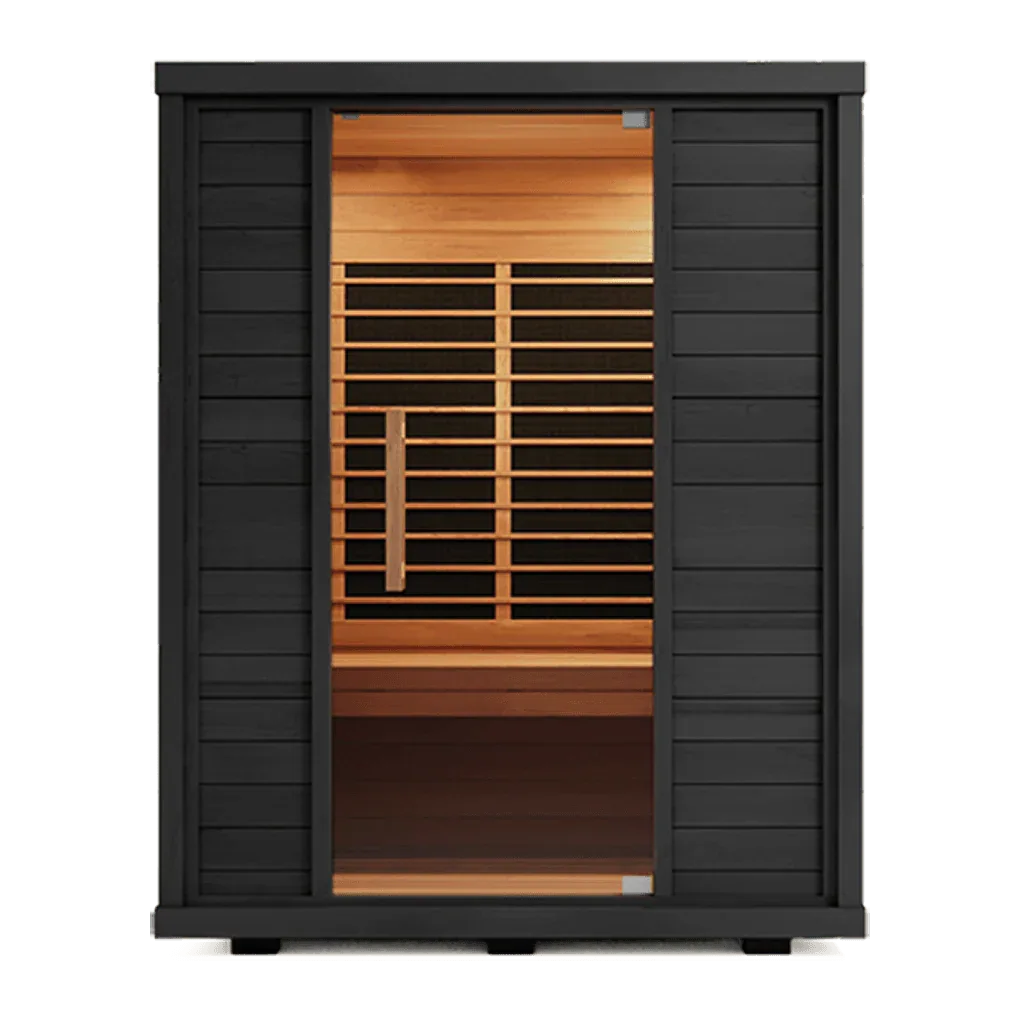
A pitch-black sauna improves sleep by removing light exposure during an evening heat session and preserving the body’s melatonin response. Zero-lux conditions raise melatonin by 30%, while temperatures above 170°F relax muscles and activate the heat response. Melatonin and HSP70 then act together, making darkness a functional part of recovery rather than a decorative feature.
The Heat-Only Myth and What the Research Actually Says
The peer-reviewed literature on traditional sauna use is legitimately compelling. Two decades of Finnish cohort studies, most prominently the KIHD study tracking 2,315 middle-aged men, document dose-dependent reductions in cardiovascular mortality, improved arterial compliance, and measurable gains in cardiorespiratory fitness at cabin temperatures between 170–200°F. The Sweat Pod reaches that range, authenticated, not approximated. But here's the variable those studies didn't control for: ambient light inside the cabin.
Conventional kit saunas are assembled with gaps at panel joints, translucent vent covers, and LED accent lighting that bleeds photons at wavelengths between 450–550 nm, the precise blue-green range the suprachiasmatic nucleus (SCN) uses to suppress melatonin synthesis via the retinohypothalamic tract. You're paying for a recovery tool that is simultaneously broadcasting a 'stay awake' signal to your endocrine system. The heat does its job. The light undoes part of it.
This matters because the two primary physiological events you want from a late-evening sauna session, heat shock protein (HSP70) upregulation and melatonin release, are not independent processes. They are synergistic. HSP70 expression, triggered by the thermal stress of sustained core temperature elevation, has been shown to modulate neuroinflammation and support glymphatic clearance, the brain's overnight waste-removal system. Melatonin, secreted by the pineal gland in the absence of light, is the scheduling signal that gates the glymphatic cycle. Block melatonin, and you weaken the downstream cascade that HSP70 was meant to prime.
Sauna Darkness Melatonin: The Pineal Gland Problem Most Brands Ignore
The pineal gland is a photosensitive endocrine organ, roughly the size of a grain of rice, suspended in the dorsal diencephalon, whose primary output, melatonin, is governed by a single input: light suppression. Specifically, light at wavelengths between 460–480 nm hitting ipRGCs (intrinsically photosensitive retinal ganglion cells) drives glutamate and PACAP signaling through the retinohypothalamic tract to the SCN, which in turn suppresses pineal N-acetyltransferase, the rate-limiting enzyme in melatonin biosynthesis.
The implication for sauna design is not subtle: any light reaching your retinas during an evening sauna session delays or reduces melatonin output. Studies measuring melatonin suppression thresholds consistently place the half-saturation point at approximately 100 lux for standard white light and as low as 30–40 lux for blue-enriched light. A typical sauna interior with LED strips or gaps in the panel assembly can register 50–150 lux, well inside the suppression zone.
Research published in the Journal of Pineal Research demonstrates that complete darkness (≤1 lux) during the evening hours can enhance melatonin secretion by up to 30% compared to dim ambient light conditions. That is not a marginal improvement. It is a measurable, mechanism-driven shift in the hormonal environment your body enters when it finally lies down. The Blackout Edition's sealed double-layer panel construction is specifically engineered to achieve zero lux inside the cabin, not 'dim,' not 'low', zero.
Blackout Engineering: What 'Zero Lux' Actually Requires
Achieving a verified zero-lux environment inside a wood-panel cabin is a genuine engineering challenge that requires solving three distinct light-intrusion vectors simultaneously: panel seam gaps, ventilation apertures, and door-frame tolerances. The Sweat Pod Blackout Edition addresses all three.
The core structural upgrade is the addition of two extra layers of protection on the side walls and roof, creating a multi-layer shell that eliminates the light paths that exist in single-skin kit sauna construction. This same double-layer construction delivers a secondary benefit: enhanced water resistance and structural durability, extending the unit's lifespan to up to 2× that of a comparable kit sauna when used outdoors. The blackout function and the weather resistance are the same feature, the sealed, multi-skin shell.
The result is a cabin that functions as a genuine Faraday environment for light. Every photon path is closed. The ventilation system maintains necessary airflow for safe oxygen exchange and humidity management without introducing light leakage, a detail most builders treat as an afterthought.
On the heating side, the Sweat Pod is available with three premium heater configurations. The flagship option, the Homecraft Revive with WiFi Controls, delivers 6 kW in the Regular (2-Person) configuration and 9 kW in the Large (4-Person) variant. WiFi control matters here for a specific circadian reason: you can pre-heat the cabin to 170°F before you enter, meaning you walk directly from your dim indoor environment into a pitch-black, fully heated chamber without delay. No standing under bright overhead lights waiting for the heater to cycle up. The Harvia KIP with built-in controls and the HUUM Drop with WiFi control are also available, all delivering authentic 170–200°F traditional heat.
The cabin ships Made in the USA, which matters for build tolerance consistency, metric-to-imperial conversion slop in imported flat-pack designs is a genuine contributor to the panel-gap light intrusion problem.
The Sleep Architecture Payoff: What Happens After You Exit
The performance case for the Blackout Edition ultimately lives in what happens after the session, not during it. Here is the sequential physiology:
During the session (0–20 minutes at 170°F+): Core temperature rises approximately 1–2°C. HSP70 expression is upregulated in skeletal muscle and neural tissue. The zero-lux environment ceases melatonin suppression; pineal N-acetyltransferase activity begins its ascent.
Post-session, 0–30 minutes: Core temperature begins falling. The rate of core temperature decline is now understood to be one of the strongest sleep-onset triggers in human physiology, a rapid post-hyperthermic drop mimics the body's natural circadian temperature decrease that precedes sleep. Melatonin output, unimpeded during the session, continues rising.
30–90 minutes post-session: Melatonin peaks. The HSP70-primed glymphatic system is opening for business. The user lies down into a hormonal and thermal environment specifically optimized for slow-wave sleep (SWS), the deep, physically restorative stage where growth hormone is secreted and cellular repair accelerates.
This is not a minor quality-of-life improvement. SWS deficiency is mechanistically linked to accelerated cognitive decline, impaired insulin sensitivity, blunted immune function, and elevated cortisol baselines. A structured evening sauna protocol using a zero-lux cabin is, by the most rigorous mechanistic reading of the evidence, a genuine longevity intervention, not a spa treat.
For users who want to extend the therapeutic light-deprivation window beyond the sauna session itself, pairing the Blackout Edition protocol with a targeted red light therapy device (used earlier in the afternoon, not the evening) can support mitochondrial function without disrupting the pre-sleep melatonin window. That is a complementary tool for a different time of day, the evening belongs to darkness.
Is the Premium Justified? A Brutally Honest Risk Analysis
The Sweat Pod Blackout Edition lists at $7,995 after the automatically applied $500 cart discount (from a $8,295 MSRP), with a 5-week lead time for production. That is a real number that deserves a real justification, not lifestyle photography.
The engineering case for the price premium: The Blackout Edition is not a standard sauna with a coat of dark paint. The additional double-layer wall and roof construction represents genuine materials cost and assembly complexity. The USA manufacturing origin ensures panel-tolerance consistency that directly determines the zero-lux performance claim. You are buying a specific physiological outcome, verifiable zero-lux + 170–200°F traditional heat, not an aesthetic variant.
Comparative context: A 3-year sleep optimization protocol involving clinical-grade sleep tracking, professional nutritional support, and pharmaceutical sleep aids (where indicated) routinely exceeds $10,000–$30,000 in total expenditure with no durable asset at the end. The Sweat Pod is a capital asset that compounds in value through daily use.
Risk reversal features that matter:
- 3-Year Warranty: Covers the heater, panel assembly, and structural components. For a unit rated to outlast standard kit saunas by 2×, this is a manufacturer putting real money behind the durability claim.
- 30-Day Trial: Use it for a month. If the sleep quality improvement doesn't materialize in your lived experience, the return pathway exists.
- Financing options available from approximately $199/month, which frames the investment not as an $8,000 outlay but as a monthly wellness infrastructure cost comparable to a mid-tier gym membership plus a sleep specialist co-pay.
- Free shipping eliminates the hidden freight cost that inflates the effective price of most competing sauna brands.
Pros
- Zero-lux cabin engineering directly addresses the melatonin-suppression mechanism that standard saunas ignore, creating a measurable sleep optimization advantage beyond heat alone
- Double-layer wall and roof construction simultaneously delivers the blackout function and 2× durability vs. standard kit saunas, two distinct value propositions from one engineering decision
- WiFi pre-heat control enables circadian-aligned session timing without light exposure delays, preserving the melatonin environment before you even enter the cabin
- USA manufacturing ensures panel tolerance consistency that is functionally prerequisite to the zero-lux performance claim
- 30-day trial, 3-year warranty, and financing from ~$199/month collectively eliminate the three primary purchase-risk objections (effectiveness, durability, affordability)
Cons
- 5-week lead time means this is a planned purchase, not an impulse solution, unsuitable for buyers who need immediate deployment
- The zero-lux benefit is maximized only with disciplined evening session timing (90–120 min pre-sleep); users without consistent schedules may realize a smaller portion of the sleep optimization value proposition
- The $7,995 price point, even with financing, represents a significant capital commitment that requires genuine behavioral follow-through to deliver ROI
FAQs
Does sauna darkness actually improve melatonin levels? Yes. Research published in the Journal of Pineal Research shows that maintaining complete darkness (≤1 lux) during evening hours can increase melatonin secretion by up to 30% compared to dim ambient light exposure. Because a typical sauna interior with LED strips registers 50–150 lux, well within the suppression threshold, eliminating all cabin light during an evening session meaningfully protects melatonin output.
What makes the Sweat Pod Blackout Edition different from a standard sauna for sleep? The Blackout Edition uses a double-layer sealed wall and roof construction that achieves a verified zero-lux interior, closes all panel-seam, ventilation, and door-frame light paths, and pairs this with WiFi pre-heat controls so you can enter a fully heated, pitch-black cabin without delay. Standard kit saunas with LED lighting or panel gaps actively suppress melatonin via blue-wavelength light at 460–480 nm, undermining the recovery benefits that heat alone provides.
How long before bed should I use a blackout sauna for the best sleep results? The optimal window is 90–120 minutes before your target sleep time. This timing aligns the post-session core temperature drop, one of the strongest physiological sleep-onset triggers, with peak melatonin output, creating compounded conditions for faster sleep onset and deeper slow-wave sleep.
Related Reading
Pros
- Zero-lux cabin engineering directly addresses the melatonin-suppression mechanism that standard saunas ignore, creating a measurable sleep optimization advantage beyond heat alone
- Double-layer wall and roof construction simultaneously delivers the blackout function and 2× durability vs. standard kit saunas, two distinct value propositions from one engineering decision
- WiFi pre-heat control enables circadian-aligned session timing without light exposure delays, preserving the melatonin environment before you even enter the cabin
- USA manufacturing ensures panel tolerance consistency that is functionally prerequisite to the zero-lux performance claim
- 30-day trial, 3-year warranty, and financing from ~$199/month collectively eliminate the three primary purchase-risk objections (effectiveness, durability, affordability)
Cons
- 5-week lead time means this is a planned purchase, not an impulse solution, unsuitable for buyers who need immediate deployment
- The zero-lux benefit is maximized only with disciplined evening session timing (90–120 min pre-sleep); users without consistent schedules may realize a smaller portion of the sleep optimization value proposition
- The $7,995 price point, even with financing, represents a significant capital commitment that requires genuine behavioral follow-through to deliver ROI
Technical Verdict
The Sweat Pod Blackout Edition resolves a genuine engineering gap in the sauna industry: the photonic environment inside the cabin. By achieving verified zero lux through a double-layer sealed shell construction, it creates the conditions for HSP70-melatonin synergy that single-skin saunas with ambient light intrusion cannot replicate. Combined with authentic 170–200°F traditional heat and WiFi-enabled circadian session timing, this is a mechanistically coherent sleep and recovery platform, not a feature-padded marketing variant.
→ View Specs & Pricing