
Imagine stepping into a private oasis of profound quiet at the end of a demanding day. The door glides shut, sealing out the noise of the modern world, and you are instantly enveloped in a deep, penetrating warmth that coaxes your nervous system out of fight-or-flight and into deep, restorative recovery. This home sanctuary is more than a luxury; it is a bio-harmonic environment designed to optimize sleep, relieve systemic stress, and accelerate cellular repair. Yet, the physical vessel of this experience, the wood itself, is not merely an aesthetic frame. It is an active thermodynamic-material interface. To truly secure this physical sanctuary, we must look past the visual appeal and examine the rigorous engineering physics that govern how different wood species react to thermal radiation, ensure chemical purity, and deliver therapeutic energy to your body.
Emissivity and Spectral Matching to Far-Infrared Emitters
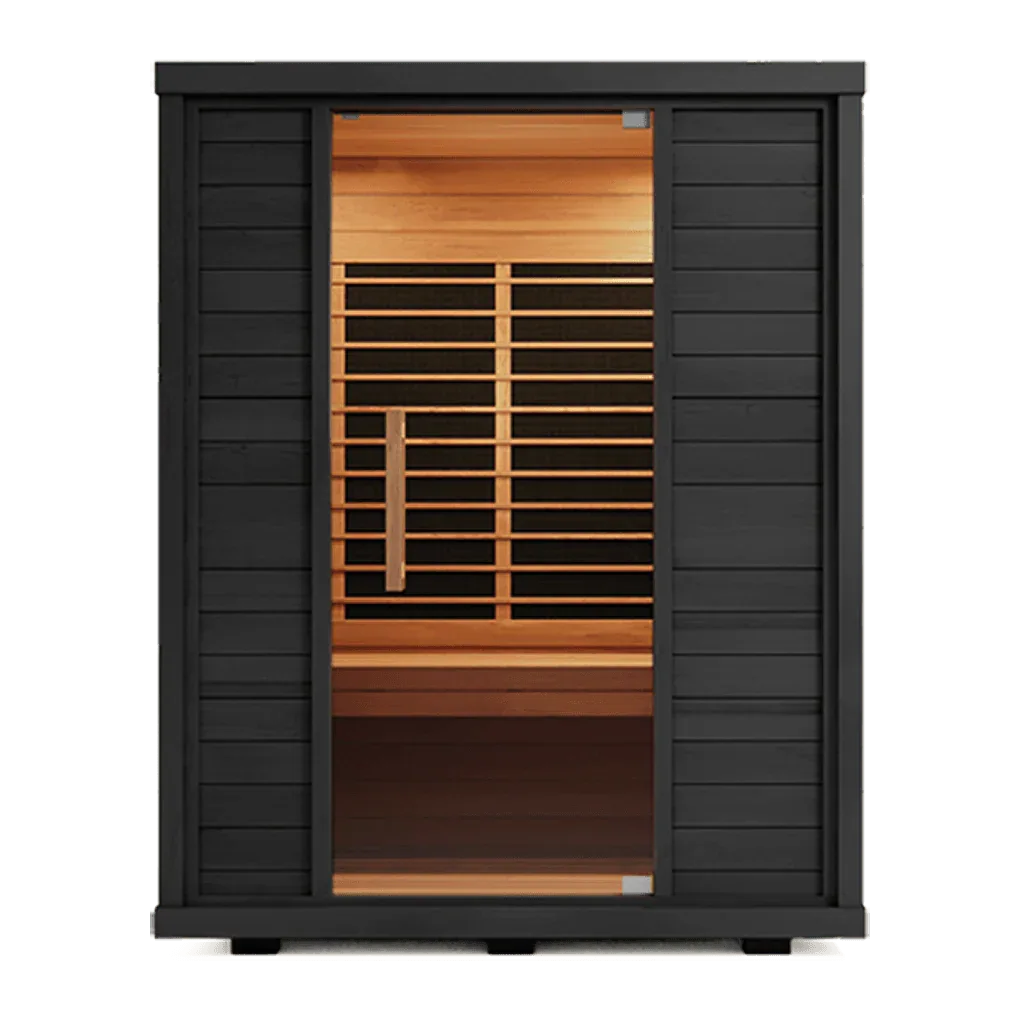
At the core of an infrared sauna's efficacy is the transfer of radiant energy. According to Planck's Law, every material emits and absorbs infrared radiation based on its temperature and surface emissivity ($\epsilon$). Within a high-performance cabin, such as the Sun Home Equinox, the interior wood lining acts as a secondary radiator. When the primary heaters emit far-infrared waves, the wood walls absorb this energy and re-radiate it back into the cabin.
Different wood species exhibit varying emissivity values in the mid- to far-infrared spectrum (4–15 $\mu$m). Premium species like Western Red Cedar and Canadian Hemlock possess exceptionally high emissivity coefficients ($\epsilon \approx 0.90$ to $0.95$). This high emissivity ensures that the wood efficiently absorbs the heater's raw radiation and converts it into a gentle, diffuse thermal field. Conversely, low-emissivity woods act as thermal mirrors, reflecting raw, unregulated wavelengths back toward the occupant. This mismatch forces the primary heaters to run at higher duty cycles, creating uneven hot spots and diminishing the gentle, therapeutic homogeneity of the environment.
Thermal Diffusivity and Surface Temperature Gradients
A sanctuary must remain comfortable to the touch. The physical behavior of the wood when exposed to continuous heat is determined by its thermal diffusivity ($\alpha$), which measures the rate at which heat passes through a material. It is mathematically defined as:
$$\alpha = \frac{k}{\rho \cdot c_p}$$
where $k$ is thermal conductivity, $\rho$ is density, and $c_p$ is specific heat capacity.
For a safe and relaxing experience, the interior cladding must have a low thermal diffusivity ($\alpha \approx 0.08 - 0.12 \text{ mm}^2/\text{s}$). Western Red Cedar and Nordic Spruce exhibit incredibly low density and high specific heat, meaning they absorb significant thermal energy without rapidly transferring it to your skin when you lean back. High-density hardwoods, such as Oak or Maple ($\rho > 700 \text{ kg/m}^3$), possess high diffusivity. They quickly become dangerously hot to the touch, disrupting your relaxation and risking surface contact burns.
VOC Off-Gassing Profiles vs Heating Cycles
The primary objective of a sauna session is cellular detoxification. But heating an enclosed space to temperatures between 40°C and 70°C can accelerate the release of volatile organic compounds (VOCs) from unsuitable materials. This phenomenon is evaluated under standards like ASTM D5116, which measures chemical emissions from indoor materials.
Many cheap, manufactured wood panels use synthetic adhesives containing urea-formaldehyde, which off-gasses aggressively under infrared loading. To maintain a truly non-toxic sanctuary, the interior must use 100% solid, untreated woods. While Western Red Cedar contains natural, aromatic cedrol and thujaplicins that provide natural antimicrobial properties, individuals with extreme chemical sensitivities may prefer highly hypoallergenic, low-terpene woods like Canadian Basswood or Aspen. These species exhibit virtually zero natural VOC emissions even at peak operational temperatures.
Dimensional Stability: Radial vs Tangential Shrinkage
An infrared sauna undergoes rapid, repeated cycles of extreme dry heat and high humidity from perspiration. This cyclic loading subjects the timber to intense hygroscopic stress. Wood stability is dictated by its volumetric shrinkage coefficient, specifically the ratio between tangential and radial shrinkage.
Vertical-grain (radial-cut) timber is highly superior to flat-sawn (tangential-cut) boards. When heated, tangential boards warp, cup, and split because wood shrinks and expands nearly twice as much along the growth rings as it does across them. Species like Canadian Hemlock and Western Red Cedar are highly prized because they possess exceptionally low volumetric shrinkage rates, ensuring that the interlocking tongue-and-groove joints remain tight, airtight, and structurally sound over decades of daily thermal cycling.
Comparative Engineering Analysis of Key Sauna Woods
Choosing the right material requires comparing the physical properties of the leading sauna timbers:
- Western Red Cedar: The industry gold standard. It features a naturally low density, exceptional decay resistance due to organic thujaplicins, and a high emissivity rate. Its rich aroma enhances psychological relaxation, though highly sensitive individuals should test their tolerance to natural cedar oils.
- Canadian Hemlock: A premier, non-allergenic option. It offers a clean, modern aesthetic with excellent structural strength and zero aroma. Hemlock heats evenly and is incredibly stable when properly kiln-dried.
- Basswood: Exceptionally hypoallergenic. Containing almost no phenols or resins, it is the wood of choice for clinical environments and users with severe chemical sensitivities.
- Nordic Spruce: A traditional option with a rustic appearance. But it contains numerous small knots that can heat up quickly and seep resin over time under direct far-infrared exposure.
If you are looking for a portable, space-saving solution that bypasses cabin timber selection while still using advanced materials, consider an alternative like the high-end Infrared Sauna Blanket, which uses medical-grade polyurethane and tourmaline layers to deliver deep-tissue heating without the structural wood footprint.
Frequently Asked Questions
Why are high-density hardwoods like oak or maple not recommended for sauna interiors?
High-density hardwoods like Oak or Maple possess high thermal diffusivity, meaning they transfer heat rapidly. Consequently, they quickly become dangerously hot to the touch when exposed to continuous heat inside the cabin. This disrupts your relaxation and risks causing surface contact burns.
Which sauna wood is best for individuals with extreme chemical sensitivities?
Highly hypoallergenic, low-terpene woods like Canadian Basswood or Aspen are the best options because they exhibit virtually zero natural VOC emissions even at peak temperatures. Basswood is particularly suited for clinical environments as it contains almost no phenols or resins. Canadian Hemlock is another excellent, non-allergenic option that offers zero aroma.
What makes Western Red Cedar a premium choice for an infrared sauna?
Western Red Cedar has a high emissivity coefficient of approximately 0.90 to 0.95, allowing it to efficiently absorb and re-radiate infrared energy as a gentle thermal field. It also possesses a low thermal diffusivity that keeps it comfortable to the touch, and natural thujaplicins that provide organic antimicrobial and decay resistance. Also its rich, natural aroma helps to enhance psychological relaxation.
Why is vertical-grain timber superior to flat-sawn wood in sauna construction?
Saunas undergo intense dry heat and humidity cycles, causing wood to shrink and expand nearly twice as much along the growth rings (tangentially) as across them. Flat-sawn boards are prone to warping, cupping, and splitting under this stress. Vertical-grain timber offers exceptionally low volumetric shrinkage, ensuring that interlocking tongue-and-groove joints remain tight and structurally sound over decades.
What are the drawbacks of using Nordic Spruce in an infrared sauna?
Although Nordic Spruce is a traditional wood option that provides a rustic appearance, it contains numerous small knots. Under direct far-infrared exposure, these knots can heat up quickly and begin to seep resin over time.
Related Reading
Pros
- Optimal emissivity matching ensures maximum biological energy absorption
- Low thermal diffusivity guarantees cool-touch seating and backrests
- Solid, adhesive-free construction eliminates toxic VOC off-gassing risk
Cons
- Premium, vertical-grain cedar carries a higher upfront material cost
- Aromatic phenols in cedar may be too intense for rare, hyper-sensitive individuals
Technical Verdict
Selecting the right sauna wood is a critical thermodynamic decision. Investing in a vertical-grain, low-diffusivity wood like Western Red Cedar or Canadian Hemlock ensures optimal far-infrared absorption, physical comfort, and absolute chemical purity.
→ View Specs & Pricing