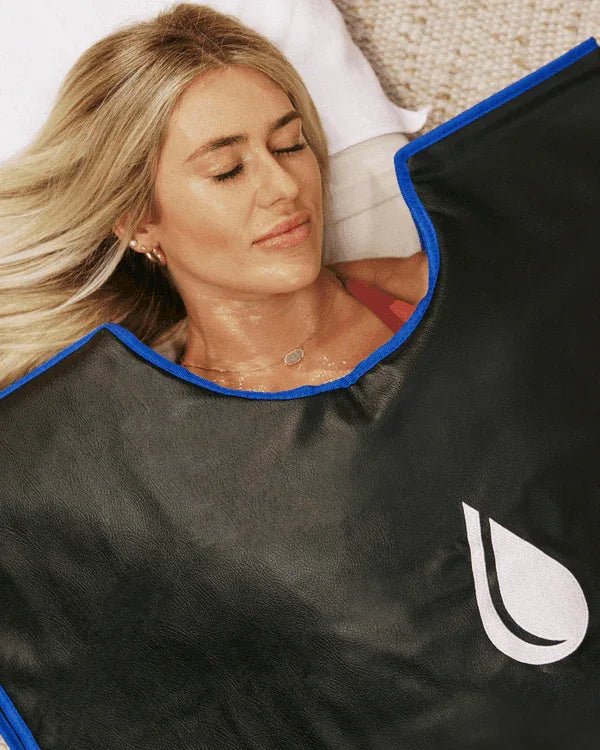
A sauna blanket helps back pain in the same way a heating pad does, and for the same reason: it warms superficial tissue, relaxes muscle, and most people feel looser for a while afterwards. It does not reach a disc, and it is not a treatment for a spinal problem. The best evidence for sauna and low back pain is a 37-patient trial of 90 °C dry sauna in which median pain fell from 5 to 3 out of 10, and 65 percent of participants improved by at least 30 percent. A blanket runs cooler than that. What a blanket does better than a cabin is posture: you lie flat.
That distinction — same heat, different dose, better position — is the whole decision, and almost nothing written about sauna blankets for back pain makes it. This page does.
What the evidence actually says
There is real published work on sauna and low back pain. None of it was done with a sauna blanket, and saying so is the honest starting point.
| Study | Design | Dose | Result |
|---|---|---|---|
| Dry sauna therapy for low back pain (J Exerc Rehabil, 2020; PMC7713799) | Prospective, single-arm, n=37, chronic low back pain over 3 months | 10 sessions: 15 min at 90 °C, twice daily for 5 days | Pain (VNRS) median 5 to 3 out of 10, p<0.001. Disability (ODI) median 12 to 8, p<0.001. 24 of 37 (65%) improved by 30% or more. No control group. |
| Masuda et al. 2005, reviewed in far-infrared sauna evidence summary (PMC2718593) | Randomised, n=46, 28 days, chronic pain | Far-infrared sauna, repeated | "Increased likelihood of return to work; trend toward decreased pain and anger." The reviewers grade it level I but call the support for chronic pain "fair preliminary". |
| Clinical effects of regular dry sauna bathing (systematic review, 2018; PMC5941775) | 36 studies: 11 Finnish, 25 infrared | Infrared arms mostly 60 °C for 15-30 min | Concludes that rigorous medical evidence for most claimed benefits is "scant and incomplete" while physiological effects are well documented. |
Three things follow, and they are the three things the listicles leave out.
First, the trial that showed a real effect used 90 °C, twice a day, for five days. That is a supervised, short, intense course. It is not the same intervention as lying in a 60 °C blanket three evenings a week, and nobody has run the blanket version of that trial.
Second, the effect measured was pain and disability, not structure. The Oswestry index moved because people reported doing daily tasks more easily. Nothing in that study suggests heat changed a disc, a facet joint or a nerve root.
Third, the result is a single-arm study with no control. Participants knew they were being heated, in a spa, for a week. That does not make the result fake — heat genuinely does reduce pain signalling and muscle spasm — but it means the effect size should be read as "people felt better" rather than "this treats back pain". The systematic review reaches the same verdict: fair preliminary support for pain, not a therapy.
Where a blanket differs from a cabin
| Heating pad | Sauna blanket | Infrared cabin | Traditional sauna | |
|---|---|---|---|---|
| What gets hot | Contact surface, ~40-45 °C | Contact surface, blankets are sold with ranges topping out near 75-80 °C | Air and surfaces, ~45-60 °C | Air and stones, ~70-90 °C |
| Your head | Room temperature | Room temperature | Heated | Heated |
| Posture | Whatever you choose | Lying flat, full body supported | Sitting upright on a hard bench | Sitting upright on a hard bench |
| Typical session | 15-20 min | 30-45 min | 30-45 min | 10-20 min |
| Where the heat lands | One patch | Whole back and legs in contact | Whole body, radiated from panels | Whole body, convective |
The posture row is the one that decides whether a back sufferer can actually complete a session. A sauna bench is a flat plank: you sit upright, unsupported, weight on your tailbone, for the length of the session. For anyone whose back is aggravated by unsupported sitting, twenty minutes of that is a back-loading exercise with heat attached. In a blanket you are horizontal and the heating element is against the lumbar region rather than radiating at it from a metre away.
That is an argument about ergonomics and compliance, not about which device produces better heat. It is also why so many back-pain buyers end up in a blanket after failing to tolerate a cabin: not because the heat is better, but because they can stay in it.
A session that a sore back can tolerate
This is our starting point, not a prescription, and it is deliberately shorter than the manufacturer's maximums:
| Week | Temperature | Duration | Frequency | What to watch |
|---|---|---|---|---|
| 1 | Lowest comfortable setting, around 50 °C | 15 min | 3 times | Whether you can lie flat without propping yourself up |
| 2 | 50-55 °C | 20 min | 3-4 times | Whether stiffness after the session is better or worse than before |
| 3+ | 55-60 °C | 25-30 min | 3-4 times | Whether you are still doing the stretching afterwards in a normal room |
Three rules that matter more than the numbers. Stop when posture fails, not when the timer does — if you are shifting, slumping or propping yourself on your hands, the session is over regardless of how good the heat feels. Stretch afterwards, out of the heat, because the window when tissue is warm is when movement is easiest and heat alone does not restore range. Do not fall asleep in it. A blanket you can sleep in is a blanket that overheats you.
Hydrate before and after. Heat is a cardiovascular load in its own right, which is why the cautions below are not boilerplate.
When to see a doctor instead of buying a blanket
Heat is the wrong tool for some backs, and a blanket is the wrong purchase for some symptoms. See a clinician rather than shopping if you have:
- numbness or tingling anywhere;
- pain radiating down a leg, or weakness in a leg or foot;
- any change in bladder or bowel control;
- back pain that followed a fall, a collision or any impact;
- fever alongside the back pain;
- back pain with unexplained weight loss.
And talk to a doctor before using any sauna if you are pregnant, have a heart condition, low or unstable blood pressure, an implanted device such as a pacemaker, a heat-sensitive condition such as multiple sclerosis, or take medication that affects sweating, blood pressure or fluid balance. This page is not medical advice.
What a blanket will not do
It will not reach a disc. Tissue depth, not temperature, is the binding constraint. A disc sits behind skin, fat and muscle, and no surface heat source you can lie on comfortably changes its temperature meaningfully.
It will not detoxify you. Sweat carries water and electrolytes; the published work on sweat excretion of environmental chemicals is small and the reviewers of the sauna literature call the detoxification evidence poorly defined. If a page sells a blanket on "flushing toxins", that page is selling.
It will not replace movement. The strongest predictor of how a back behaves over years is what you ask it to do, not how often you heat it. A blanket is a comfort and compliance tool that makes the rest of the routine possible.
What to check before you buy
- Heating coverage across the lumbar region. Some blankets heat in zones; you want the lower back covered at the same intensity as the shoulders, not a single zone across the middle.
- Flat length. If you are tall, a short blanket means your knees are bent or your feet are cold, and both make lying still harder. Check the internal length against your height.
- Timer ceiling and auto shut-off. A 60-minute ceiling with automatic cut-off is the safety feature that matters for anyone lying down.
- A washable insert. You will sweat into it every session; a removable towel liner is the difference between a wipe-down and a laundry problem.
- Published EMF figures, with a distance. "Low EMF" is not a specification. Ask for a reading in milligauss at torso position, and read what the mG numbers mean before you compare two blankets on it.
If your pain is inflammatory rather than mechanical — rheumatoid arthritis, for instance — the protocol and the cautions are different, and the arthritis-specific guidance is here. If you are weighing a blanket against a cabin more generally, the differences that actually change the experience are set out here. And if you are buying it for training recovery rather than back pain, the 30-day recovery record is here.
Frequently asked questions
Does a sauna blanket help back pain?
It can ease it. Heat reduces pain signalling and muscle spasm, and a prospective trial of 37 chronic low-back patients found median pain falling from 5 to 3 out of 10 after ten 90 °C dry-sauna sessions. That trial used a cabin at a much higher temperature than a blanket reaches, and had no control group, so treat the blanket version as plausible rather than proven.
Is a sauna blanket or a cabin better for lower back pain?
For most people with mechanical low back pain, a blanket is easier to tolerate, because you lie flat instead of sitting unsupported on a bench for twenty minutes. A cabin delivers a higher dose and has the better evidence base. If you can sit comfortably in a cabin, the cabin wins on dose; if you cannot, the blanket you actually use beats the cabin you avoid.
How hot should a sauna blanket be for back pain?
Start at the lowest comfortable setting, around 50 °C, for 15 minutes, and work up to 55-60 °C for 25-30 minutes over three to four weeks. The blankets are usually sold with ranges that go higher, up to about 75-80 °C; there is no evidence that the maximum setting helps a back more, and the higher settings shorten the time before posture fails.
How often should I use it?
Three to four sessions a week is a sensible routine, and it matches the frequency used in the published sauna studies. Daily use is not obviously better for pain, and it is a larger heat load. Consistency over weeks matters more than session length.
Can I use a sauna blanket for sciatica?
Ask a clinician first. Pain radiating down a leg is a different presentation from mechanical low back pain, and it is on the list of symptoms that deserves an examination rather than a purchase. Heat may still be appropriate, but that is a diagnosis question, not a product question.
Is it safe to fall asleep in a sauna blanket?
No. Lying down makes overheating easier, and the blankets are designed to be used awake with a timer. Use the auto shut-off, set the timer below your usual session length while you are learning your tolerance, and get out if you feel dizzy or light-headed.