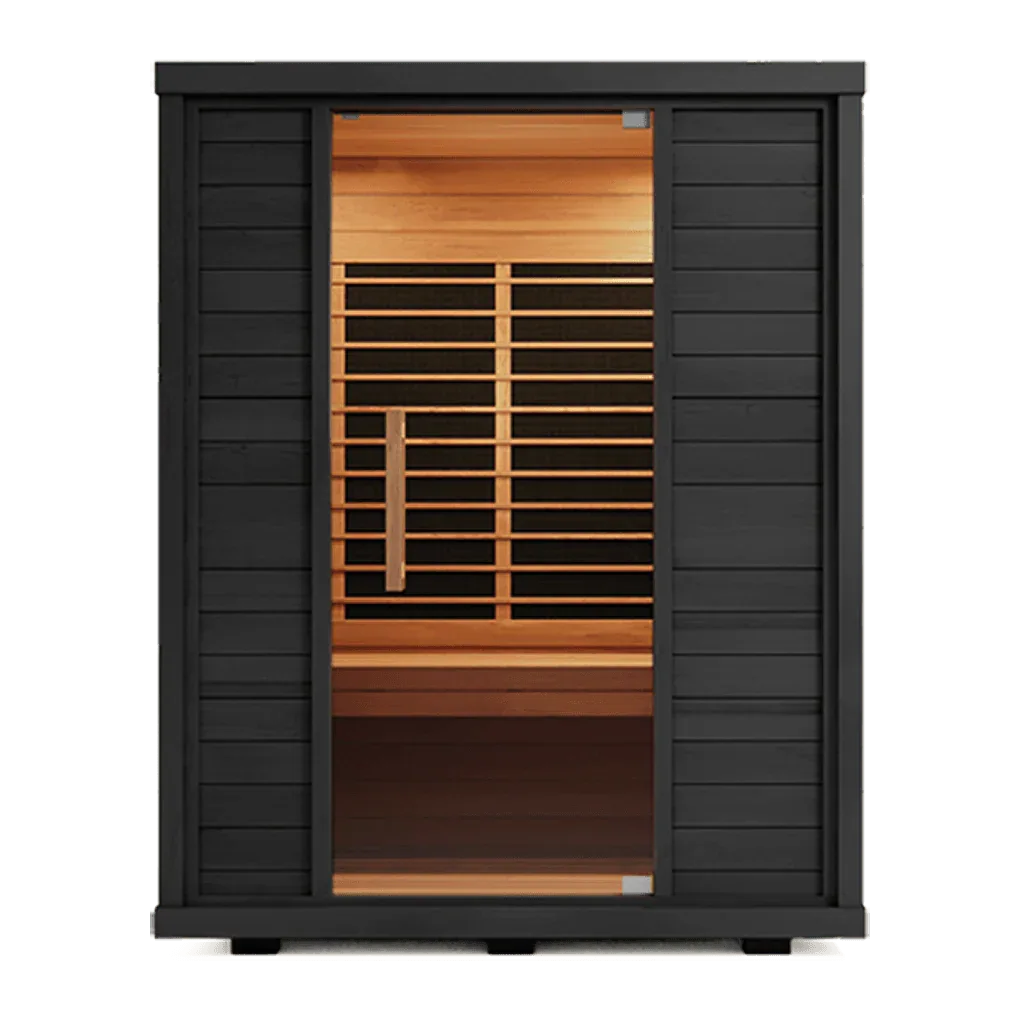
Picture the ultimate return to equilibrium. You step inside a private cabin of raw, aromatic cedar, shutting out the relentless noise of the digital world. As the ambient warmth envelopes you, a deep, cellular relaxation takes hold. Your heart rate variability improves, your muscles release their accumulated tension, and your mind settles into a state of profound calm. This is not merely a home luxury; it is your personal sanctuary for longevity, stress resilience, and deep, restorative sleep.
Yet, to translate this somatic sanctuary into reality, we must look beyond the premium woodwork and analyze the engineering at the heart of the experience: the infrared heating elements. Choosing between carbon and ceramic emitters is not a matter of aesthetic preference. It is a decision that dictates the exact wavelengths of light that will interact with your biology, governing tissue penetration depths, sweat volumes, and your body's physiological response. To make an investment that truly serves your health, we must ground our emotional desire for rejuvenation in the uncompromising physics of infrared energy.
Spectral Emission Profiles: Physics of the Infrared Spectrum
To understand how different emitters interact with human tissue, we must first establish their physical parameters. Infrared radiation is categorized by wavelength, governed by Planck's Law and Wein's Displacement Law, which dictate that the peak emission wavelength of any blackbody radiator is inversely proportional to its absolute temperature.
While the consumer wellness industry frequently uses the terms "near-infrared" and "far-infrared" loosely, the international standard ISO 20473 strictly defines these spectral boundaries:
- Near-Infrared (NIR): 0.78 to 3.0 µm
- Middle-Infrared (MIR): 3.0 to 50 µm
- Far-Infrared (FIR): 50 to 1000 µm
Under this rigorous framework, carbon and ceramic heaters exhibit distinct emission profiles. Ceramic emitters run at substantially higher surface temperatures (typically 350°C to 500°C), shifting their peak emission spectrum toward shorter wavelengths, generally between 2.0 and 4.0 µm. This places their output primarily on the boundary of Near-Infrared and Middle-Infrared. Carbon heaters, by contrast, distribute their electrical energy over a much larger surface area, operating at lower temperatures (around 60°C to 100°C). According to Wein's Law, this lower temperature shifts their peak emission output to 5.0 to 8.0 µm, placing them firmly within the Middle-Infrared band (often commercially referred to as far-infrared).
This spectral distinction matters because the human body is not a passive receiver; it is a selective absorber of electromagnetic radiation. Understanding which wavelengths match your body's biological windows is the key to selecting the right emitter technology. For those seeking a comprehensive, full-spectrum experience that combines the deep penetration of shorter wavelengths with the gentle warmth of longer waves, the Sun Home Equinox offers an engineered, balanced approach. Sun Home Saunas
Tissue Absorption Depth: The Biophysics of Attenuation
When infrared energy strikes the skin, its path is governed by the Beer-Lambert Law, which describes how light is attenuated as it travels through a medium. The depth to which infrared energy penetrates is determined by the absorption coefficient ($\alpha$) of human tissue, which is primarily composed of water, melanin, and hemoglobin at various depths.
Water is highly reflective and absorptive to longer wavelengths. Because the epidermis and dermis are highly aqueous, middle-infrared wavelengths between 5.0 and 8.0 µm (emitted by carbon heaters) are rapidly absorbed by water molecules in the very top layers of the skin. Approximately 90% of this energy is absorbed within the first 0.1 to 1.0 mm (the epidermis and upper dermal junction). This triggers a rapid superficial thermal sensation, causing your body to perceive high heat and initiate a heavy, water-rich sweat response via eccrine glands.
Conversely, near-infrared wavelengths between 0.78 and 1.4 µm (often emitted by ceramic or high-end halogen-quartz elements) fall into what biophysicists call the "optical window of tissue." Within this band, water absorption is significantly lower, allowing the photons to penetrate up to 2.0 to 5.0 mm into the subcutaneous tissue. This deeper penetration directly targets vascular capillary beds, nerves, and deeper muscle layers, facilitating systemic vasodilation and deep-tissue relief.
If your goal is targeted muscle recovery and deep cellular interaction, choosing an emitter that delivers these penetrating wavelengths is essential. Portable options like the Infrared Sauna Blanket use carbon layouts for highly efficient, surface-level sweating in a compact footprint, proving that both technologies have distinct biological use cases.
Biochemical Pathways: Cytochrome c Oxidase vs. TRPV Activation
The physiological differences between carbon and ceramic emitters go far beyond simple temperature changes; they activate entirely different biochemical pathways at the cellular level.
1. Mitochondrial Stimulation via Near-Infrared (Ceramic/NIR) When near-infrared light (specifically in the 800–1000 nm range) penetrates deep into the tissue, it is absorbed by Cytochrome c Oxidase (CcO), the terminal enzyme in the mitochondrial electron transport chain. This photobiomodulation effect excites the enzyme, displacing nitric oxide (NO) and allowing oxygen to bind more efficiently. The results are threefold:
- Upregulated Adenosine Triphosphate (ATP) Synthesis: Enhances cellular energy and accelerates tissue repair.
- Controlled Nitric Oxide Release: Promotes local vasodilation, improving nutrient delivery and lowering blood pressure.
- Mild Retrograde Oxidative Stress: Triggers a hormetic response, upregulating endogenous antioxidants like superoxide dismutase.
2. TRPV Channel Activation via Middle-Infrared (Carbon/MIR) Because carbon emitters peak in the 5.0 to 8.0 µm range, their energy is absorbed superficially, raising the temperature of keratinocytes in the epidermis. This thermal shift activates Transient Receptor Potential (TRP) ion channels, specifically TRPV1 and TRPV4. This activation triggers:
- Rapid Sweat Output: Prompting the body to initiate solid thermoregulation.
- Beta-Endorphin Release: Providing a powerful systemic analgesic effect and a deep sense of tranquil well-being.
For those looking for targeted cellular photobiomodulation without the intense ambient heat of a full cabin, using dedicated panel systems like the Novaa Pro can provide the exact wavelengths needed to stimulate the mitochondrial pathway. NovaaLab
Energy Density and Heat Flux: Engineering the Thermal Sanctuary
To design a home sanctuary that you will use consistently, the quality of the thermal environment is just as important as the cellular chemistry. This is where energy density and radiative heat flux play a critical role.
Ceramic heaters are point-source emitters. Because they operate at high temperatures (generating 1200–2000 W of total power over a small surface area), they output a high radiative flux of 800–1200 W/m². This high density heats up the sauna cabin very quickly, but it also creates intense, localized "hot spots." If you sit too close to a ceramic element, the intense heat flux can trigger TRPA1 pain receptors in the skin, leading to a stinging sensation that makes it difficult to relax.
Carbon heaters operate on the opposite principle. By distributing 600–900 W of power across massive, flat carbon panels, they output a much lower, gentler heat flux of 300–500 W/m². This creates an incredibly uniform thermal envelope. There are no hot spots or cold corners; instead, you are surrounded by a soft, ambient warmth that allows you to remain inside the cabin longer. This prolonged exposure is critical, as clinical cardiovascular benefits, such as endothelial function improvements, are heavily dependent on cumulative, sustained core temperature elevation (a moderate rise of $\Delta T \sim 0.5\text{, }1.0^\circ\text{C}$) rather than short, painful bursts of extreme heat.
Pros
- Hybrid Carbon/Ceramic heaters deliver both deep mitochondrial stimulation and sweat-inducing ambient heat
- Low-EMF shielded carbon panels ensure a clean, medically supportive thermal environment
- Sustained, comfortable heat flux encourages longer sessions for maximum cardiovascular and autonomic nervous system benefits
Cons
- Full-spectrum premium cabins require a higher initial financial investment compared to basic portable options
- Requires a dedicated residential space and a standard or dedicated electrical circuit depending on cabin size
Technical Verdict
When choosing between carbon and ceramic, the optimal biological choice is not an 'either/or' scenario. The most sophisticated therapeutic outcomes are achieved by combining the deep cellular photobiomodulation of near-infrared ceramic elements with the uniform, highly-tolerable thermal envelope of carbon panels.
→ Explore Sun Home Equinox Specs & Pricing