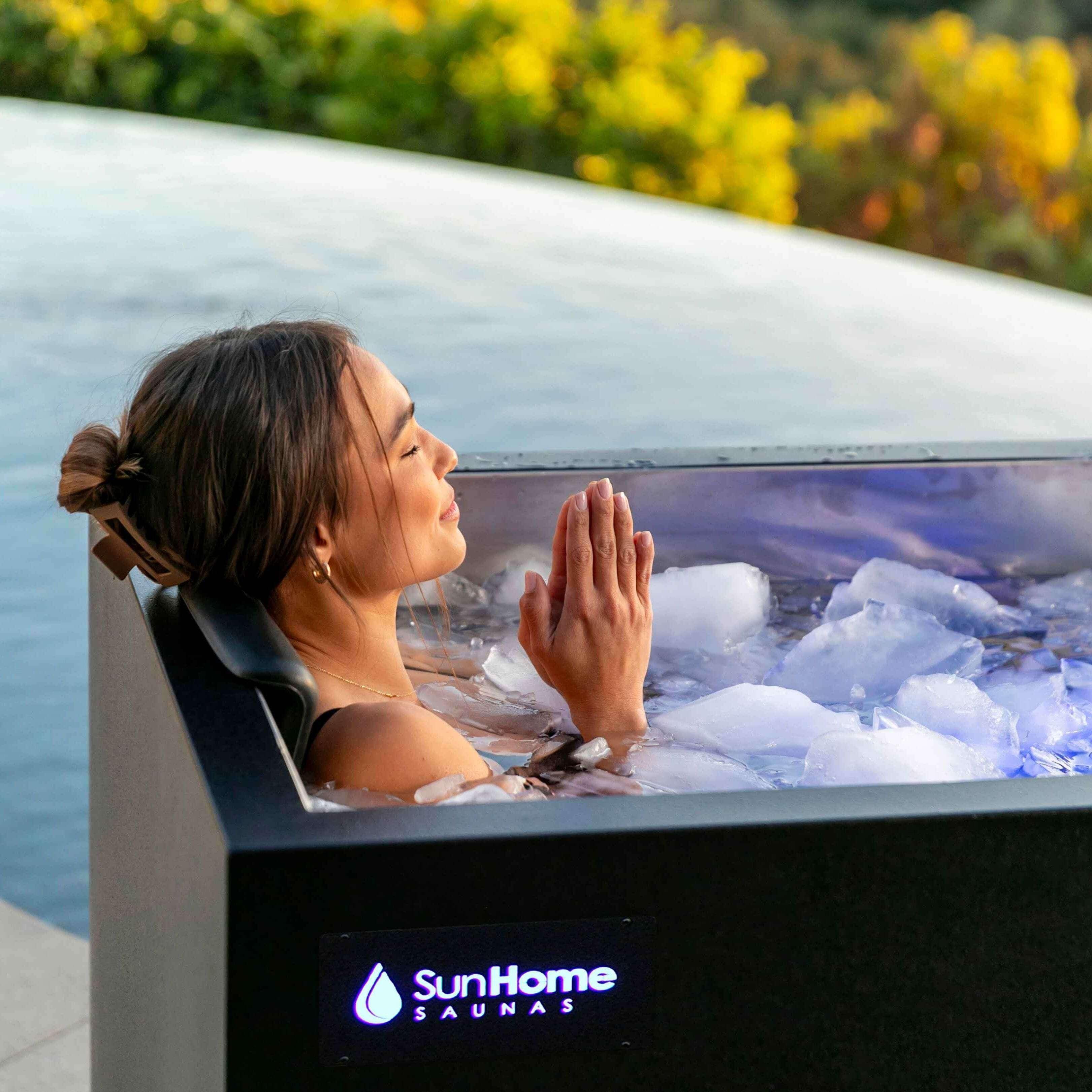

Imagine returning home after a relentless day, stepping into your private sanctuary, and immersing yourself in a pristine, bone-chilling cold that instantly silences the mental chatter. Within seconds, your sympathetic nervous system fires, blood rushes to your core, and a profound sense of physical restoration washes over you. This daily ritual is more than a wellness trend; it is a structural gateway to deep autonomic recovery, optimized sleep, and cognitive clarity. But to transform this practice into an effortless lifestyle upgrade, your recovery sanctuary must perform with absolute thermodynamic precision. While many wellness enthusiasts debate the aesthetics of modern ice baths, the real therapeutic distinction between high-end inflatable structures and classic stainless steel hinges on a hidden battle: the divergence of material heat-transfer coefficients and their direct impact on water temperature stability. Discover how the Sun Home Cold Plunge Pro Sun Home Saunas balances these physical laws to deliver an uncompromising recovery experience.
Thermal Inertia vs. Thermal Conductivity: The Physics of Water Temperature Maintenance
The fundamental performance of any cold plunge relies on conductive heat transfer, governed mathematically by Fourier's Law of Thermal Conduction: $q = -\kappa \nabla T$. In this equation, $q$ represents heat flux, $\kappa$ is the material's thermal conductivity, and $\nabla T$ is the temperature gradient. When evaluating cold plunge materials, the thermal conductivity coefficient $(\kappa)$ determines how rapidly your tub exchanges heat with the surrounding environment.
Stainless steel (typically ASTM A240 Grade 304 or 316) possesses a exceptionally high thermal conductivity of approximately $16 \text{ W/m}\cdot\text{K}$. This means steel acts as an efficient heat exchanger, rapidly pulling ambient warmth from the surrounding air and transferring it directly into your chilled water. Without a massive, continuously running chiller, a steel ice bath suffers from rapid thermal drift, causing the water temperature to climb steadily during warm days.
In contrast, high-end inflatable tubs are engineered using multi-layer drop-stitch polyvinyl chloride (PVC) combined with high-density polyurethane or closed-cell foam cores. These materials exhibit a thermal conductivity coefficient of just $0.024 \text{ to } 0.035 \text{ W/m}\cdot\text{K}$, nearly three orders of magnitude lower than stainless steel. The insulated walls of an advanced inflatable act as a highly effective thermal barrier. By dramatically restricting heat flux, they lock in the target temperature, ensuring that your sanctuary remains at its therapeutic set point with minimal energy draw.
Cold-Shock Pathway Fidelity: How Material-Driven Temperature Fluctuations Alter Physiological Response
The biological efficacy of cold-water immersion is not a binary state; it is a highly regulated, dose-dependent physiological cascade. The primary molecular trigger for this cascade is the activation of Transient Receptor Potential Melastatin 8 (TRPM8) ion channels in mammalian sensory neurons. TRPM8 channels are highly sensitive to thermal gradients, initiating a massive influx of calcium ions when skin temperature drops below $26\text{°C}$, with peak activation occurring precisely between $10\text{°C}$ and $15\text{°C}$.
Once activated, the TRPM8 pathway triggers a profound autonomic response: solid shivering thermogenesis, sympathetic vasoconstriction, and the systemic upregulation of cold-shock proteins. Chief among these is RNA-binding motif protein 3 (RBM3), a cold-shock protein synthesized in the brain and skeletal muscle that has been shown to support neuroprotection and muscle protein synthesis.
To maximize this cellular response, the thermal stimulus must remain perfectly stable throughout your session. If a cold plunge tub lacks proper insulation, the introduction of warm human body mass (typically at $37\text{°C}$) causes immediate localized warming, creating a thermal boundary layer that blunts the activation of TRPM8. While uninsulated steel tubs experience localized temperature spikes that interrupt this biochemical signaling, high-performance insulated systems like the Sun Home Cold Plunge Pro Sun Home Saunas maintain a stable, uniform temperature field. This precise, uninterrupted thermal gradient ensures maximum cold-shock protein transcription and autonomic engagement.
Biofilm Energetics and Material Surface Topography: Hygiene Implications at 10–15 °C
Maintaining pristine, sanitary water is critical for any home sanctuary. The ease with which you can keep your cold plunge clean depends heavily on the surface topography of the tub material and how it interacts with microscopic pathogens like Pseudomonas aeruginosa.
While stainless steel is often perceived as sterile, it is highly susceptible to microscopic pitting, weld-line crevices, and localized galvanic corrosion when exposed to chemical sanitizers like chlorine, bromine, or ozone. These micro-fissures (characterized by high surface roughness, or $R_a$ values) provide perfect anchoring points for bacterial attachment. Once bacteria colonize these microscopic valleys, they secrete extracellular polymeric substances (EPS) to form a protective biofilm. These biofilms shield bacteria from sanitizing agents, allowing pathogens to multiply even in cold, $10\text{°C}$ environments.
High-density, UV-resistant drop-stitch PVC features an incredibly smooth, non-porous elastomeric surface with an exceptionally low $R_a$ value. Without microscopic crevices to cling to, bacteria are easily swept away by the integrated filtration system. When paired with advanced sanitization protocols, the non-porous surface of high-end inflatables prevents biofilm formation, ensuring your water remains genuinely clean, clear, and inviting.
Structural Load and Insulation Trade-Offs: Static vs. Dynamic Cooling Systems
A standard cold plunge tub holds approximately $400 \text{ liters}$ of water, translating to a static physical load of $400 \text{ kg}$ ($880 \text{ lbs}$), excluding the weight of the user and the tub itself. Managing this massive load while maintaining thermodynamic efficiency is a primary engineering challenge.
Stainless steel tubs require heavy internal structural framing to prevent bowing and warping under load. Because steel has no structural elasticity, any shifting in the subfloor can place intense stress on weld seams, potentially leading to catastrophic leaks over time. Also to add insulation to a steel tub, manufacturers must inject expanding foam between the steel liner and an outer cabinet, creating a bulky, heavy, and completely static appliance that cannot be easily moved.
Modern high-density drop-stitch PVC engineering solves this structural challenge dynamically. By connecting the upper and lower layers with tens of thousands of high-tensile polyester fibers, these walls can be pressurized up to $15 \text{ PSI}$. At this pressure, the inflatable wall achieves a rock-hard structural rigidity that easily supports the lateral hydro-static pressure of $400 \text{ kg}$ of water. This pressurized air-core structure inherently acts as a highly effective double-walled thermal insulator. This unique combination delivers supreme structural strength, excellent thermal barrier properties, and the unique flexibility to drain, deflate, and relocate your recovery sanctuary whenever you choose.
Cost-Per-Cycle Analysis: Energy Demands of Stainless Steel Chillers vs. Passive Foam Insulation
To understand the true cost of ownership, we must look beyond the initial purchase price and evaluate the daily energy demand of maintaining a cold sanctuary. A chiller's power consumption is directly proportional to the thermal load placed on the system by heat leaking through the tub walls.
Consider an uninsulated stainless steel tub keeping water at $10\text{°C}$ in a $25\text{°C}$ ambient room. Because steel conducts heat so efficiently, the chiller's compressor must run constantly, experiencing a duty cycle of $45% \text{ to } 60%$, to combat continuous thermal gain. This high duty cycle not only leads to significant monthly electricity costs but also accelerates wear on the compressor, shortening the operational lifespan of your chiller.
An insulated inflatable tub reduces thermal gain by up to $85%$. This thermal efficiency allows the chiller's compressor to operate on a highly efficient $10% \text{ to } 15%$ duty cycle, running briefly to offset minor thermal losses before resting. This passive thermal retention saves owners substantial energy costs every month while drastically extending the lifetime of the chiller. With flexible financing options starting from just $199/month, a lifetime warranty, and free shipping, investing in a highly insulated recovery system like the Sun Home Cold Plunge Pro Sun Home Saunas is both a scientifically superior and economically sound choice.
Empirical Validation Protocol: Standardizing Temperature Logging and User Exposure Time
To achieve reproducible, clinical-grade results from your cold exposure routine, you must establish an empirical validation protocol. The goal is to eliminate variables, ensuring that every session delivers the precise physiological stimulus required for metabolic and neuroendocrine adaptation.
First, standardize your temperature logging. Avoid relying solely on basic digital sensors, which can experience calibration drift over time. Instead, use a high-quality submerged probe to confirm that your water remains steadily within the target $10\text{°C to } 12\text{°C}$ therapeutic range.
Second, target a weekly cumulative exposure of $11 \text{ minutes}$. This threshold, supported by clinical recovery literature, is highly effective when broken down into 3 to 4 sessions of 3 minutes each. During each session, focus on controlled, diaphragmatic breathing to suppress the initial cold-shock gasping reflex, allowing your body to settle into a deep parasympathetic state. By combining a scientifically validated exposure protocol with the uncompromising thermal stability of a premium, insulated cold plunge, you transform a simple cold bath into a lifetime of physiological resilience and mental mastery.
Frequently Asked Questions
Why does an inflatable cold plunge hold water temperature better than a stainless steel one?
Inflatable tubs made of multi-layer drop-stitch PVC and foam cores have an exceptionally low thermal conductivity of 0.024 to 0.035 W/m·K, which acts as a highly effective thermal barrier. Conversely, stainless steel has a much higher thermal conductivity of approximately 16 W/m·K, meaning it rapidly conducts ambient warmth into the chilled water. Consequently, uninsulated steel tubs experience rapid thermal drift, whereas insulated inflatables lock in the target temperature with minimal energy draw.
How do temperature fluctuations in an ice bath affect the physiological benefits of cold therapy?
The benefits of cold-water immersion are highly dose-dependent and rely on the activation of TRPM8 ion channels, which peak between 10°C and 15°C to trigger cold-shock proteins like RBM3. When a user enters an uninsulated tub, their 37°C body mass causes localized warming that can blunt this biological pathway. Insulated systems maintain a stable, uniform temperature field to ensure uninterrupted cold-shock protein transcription and autonomic engagement.
Are stainless steel ice baths more hygienic than inflatable PVC tubs?
While stainless steel is often perceived as sterile, it is actually highly susceptible to microscopic pitting, weld-line crevices, and corrosion from chemical sanitizers, which give bacteria like Pseudomonas aeruginosa a place to form protective biofilms. High-density drop-stitch PVC features a smooth, non-porous elastomeric surface with no microscopic crevices. This makes it much easier for integrated filtration systems to sweep bacteria away and prevent biofilm buildup.
Related Reading
Pros
- Exceptional thermal insulation prevents water temperature drift
- Highly sanitary, non-porous PVC surface resists bacterial biofilms
- Reduced energy consumption and less wear on the chiller compressor
- Rigid drop-stitch construction provides portability without sacrificing strength
Cons
- Higher initial investment than uninsulated basic tubs
- Requires periodic pressure checks to maintain optimal 15 PSI rigidity
Technical Verdict
From an engineering standpoint, uninsulated stainless steel ice baths act as highly efficient radiators that continuously fight against your chiller. Modern pressurized, drop-stitch insulated structures solve this thermodynamic challenge, preserving the exact temperature required for TRPM8 activation while using a fraction of the electricity.
→ View Specs & Pricing