2-Person vs 3-Person Infrared Sauna: Space and Price Tradeoffs
For many, designing a home wellness sanctuary is the ultimate step toward reclaiming personal peace, optimizing recovery, and securing deep, restorative sleep. Sweating out the day's stress in a private cabin of gentle, deep-penetrating infrared heat is an unmatched ritual. Yet, when transitioning from aspiration to investment, buyers inevitably face a practical crossroads: choosing between a compact 2-person unit and a slightly larger 3-person cabin. This guide explores the 2-Person vs 3-Person Infrared Sauna: Space and Price Tradeoffs to help you decide.
Standard Dimensions and Weight Comparison of 2-Person vs 3-Person Infrared Saunas
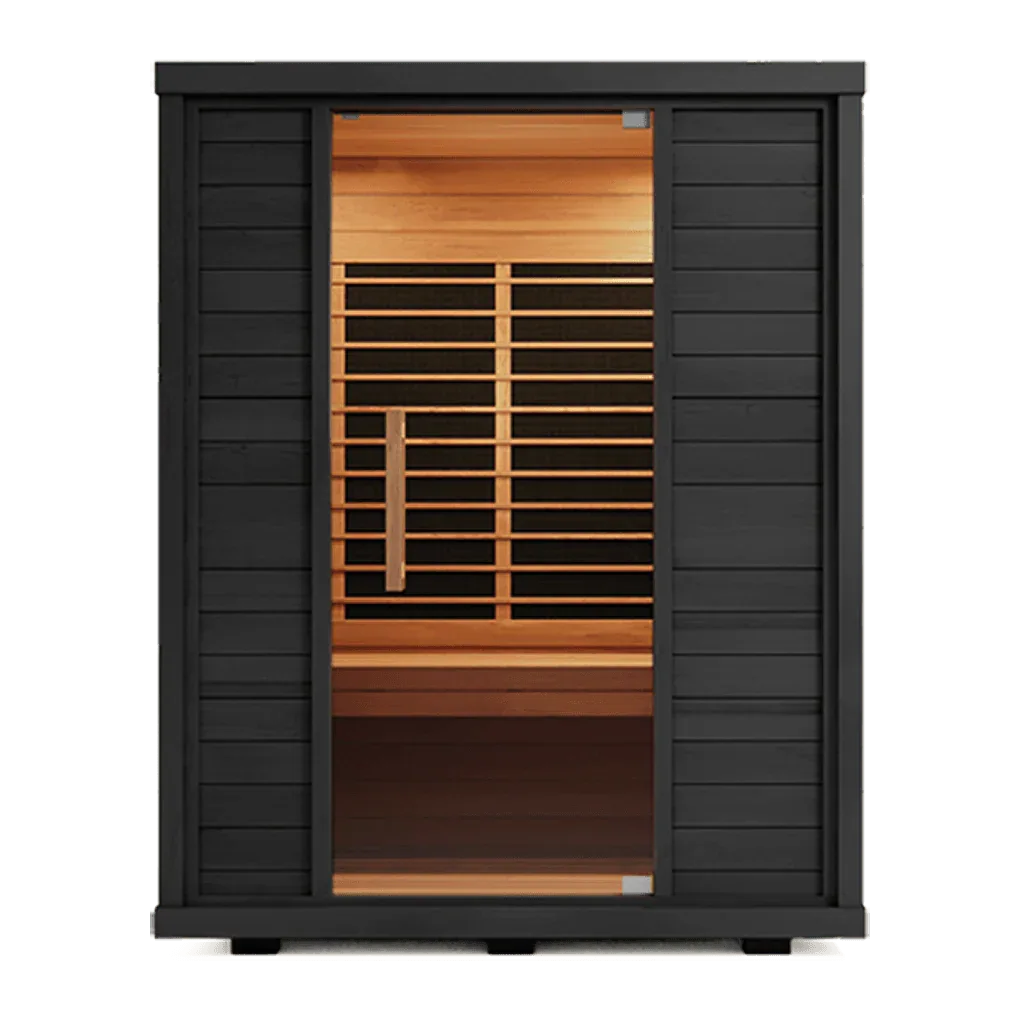
A 2-person infrared sauna dimensions average 50"W x 44"D x 75"H and weigh 250 lbs, while 3-person infrared sauna dimensions average 67"W x 60"D x 75"H and weigh 350 lbs, requiring significantly more floor space.
Typical 2-Person Sauna Dimensions
The standard 2-person infrared sauna dimensions usually measure roughly 50 inches wide by 44 inches deep, with a consistent exterior height of 75 inches. These proportions yield an exterior footprint of approximately 15.3 square feet. Inside, the bench width typically spans 46 to 48 inches. This is wide enough for two average-sized adults to sit side-by-side with minimal shoulder clearance, but it does not allow either occupant to stretch out or recline comfortably.
Typical 3-Person Sauna Dimensions
Stepping up, the typical 3-person infrared sauna dimensions stretch to roughly 67 inches wide by 60 inches deep. While the height remains at 75 inches to clear standard 8-foot residential ceilings, the footprint expands to nearly 28 square feet. This footprint represents an 80% increase in sauna floor space compared to the 2-person variant. The extended width allows for a bench length of up to 63 inches, enabling a single user to lie down completely or three individuals to sit comfortably without rubbing shoulders.
Weight Differences and Floor Loading
The structural weight also scales up with size. A standard 2-person model has an infrared sauna weight of approximately 250 lbs, while a 3-person cabin increases to about 350 lbs. When accounting for multiple users, a fully occupied 3-person sauna can exert a static load of 750 to 900 lbs. Fortunately, standard modern residential flooring is designed to handle this load safely, as the heavy tongue-and-groove wooden panels distribute the weight evenly across the flat bottom runner rails.
2-Person vs 3-Person Infrared Sauna: Space and Price Tradeoffs
2-person saunas cost $1,500-$3,500, while 3-person saunas cost $2,500-$5,500, a price increase of roughly 50-70% for the larger size, but cost per square foot sauna is often similar.
Average Price Ranges
For an entry-level to mid-range unit, the average 2-person sauna cost ranges between $1,500 and $3,500. These price points typically feature Canadian hemlock construction and standard carbon or ceramic far-infrared heating panels. In contrast, the 3-person sauna cost spikes to a range of $2,500 to $5,500. This tier often includes extra structural materials, red cedar options, and advanced heating tech like full-spectrum panels.
Cost per Square Foot Analysis
When calculating the cost per square foot sauna owners actually pay, the economy of scale favors the larger unit. A mid-range 2-person sauna priced at $2,200 offers about 15.3 square feet of floor space, costing roughly $143 per square foot. A mid-range 3-person model priced at $3,400 provides 27.9 square feet of floor space, which drops the unit cost to $121 per square foot. If you have the floor space, the larger cabin offers better relative value for the raw materials and interior volume you receive.
Hidden Costs: Shipping, Installation, and Accessories
The raw infrared sauna price is rarely the final cost of getting the unit up and running. Shipping large wooden crates can add $200 to $400 in freight fees if not covered by a free shipping promotion. Additionally, professional sauna installation cost factors must be weighed. Assembly is usually a two-person job, but hiring helper labor runs around $150 to $300. Upgrading your setup with ergonomic backrests, chromotherapy lighting packages, or specialized bench pads can add another $100 to $350 to the final bill.
Space Requirements: Footprint and Clearance for Installation
A 2-person sauna needs about 4x4 feet of floor space plus 12 inches of wall clearance, while a 3-person sauna requires about 5.5x5 feet; both need at least 4 inches of ceiling clearance.
Actual Footprint of Each Size
Before purchasing, you must plan for both the physical footprint and the functional space required around the unit. A 2-person cabin occupies a physical footprint of roughly 4.2 feet by 3.6 feet. By contrast, a 3-person cabin demands a physical envelope of roughly 5.6 feet by 5 feet. This added width can make it tough to fit the unit into standard walk-in closets or small bathroom corners.
2-Person Footprint:  [ 50" W x 44" D ]  --> Fits easily in master baths or closets.
3-Person Footprint:  [ 67" W x 60" D ]  --> Best for gym rooms, basements, or garages.
Clearance Needs for Ventilation and Maintenance
To ensure safe operation, manufacturers specify precise sauna clearance guidelines. Both sizes require at least 4 inches of clear overhead space above the roof cap to allow heat to escape from the control box. Additionally, you should maintain a 12-inch corridor of sauna installation space on at least one side (or the rear) to access external power supply connections and perform future maintenance. Finally, account for the 24-inch door swing radius to avoid blocking nearby cabinets, walkways, or bathroom fixtures.
Room Size Recommendations for Typical US Homes
To install a sauna comfortably, your home's layout needs to support these physical footprints.
- 2-Person Units: These fit comfortably in a standard master bathroom, a large walk-in closet, or a small home gym corner.
- 3-Person Units: These are best suited for a dedicated spare bedroom (such as a 10x12 room), a finished basement, or a temperature-controlled garage.
Always measure your room's entryways, hallways, and stairwells before ordering to ensure the flat-packed shipping boxes can physically reach their final destination.
Electrical Requirements: 120V vs 240V and Breaker Needs
Most 2-person saunas run on a standard 120V outlet (2000W) and do not require special wiring, while larger 3-person models often need a 240V dedicated circuit (3000W) and professional installation, adding significant cost.
Power Consumption Differences
Understanding infrared sauna electrical requirements is crucial to avoiding post-purchase headaches. A typical 2-person cabin draws between 1,600 and 2,000 watts during its initial heat-up cycle. A larger 3-person unit draws between 2,400 and 3,300 watts due to the increased cubic volume it must heat. This higher wattage translates directly to increased sauna power consumption, though the operating cost remains low—averaging roughly $0.35 to $0.65 per 45-minute session based on US residential utility rates.
Plug vs Hardwired Setup
The choice between 120V vs 240V sauna models determines how easy the unit is to install:
- 120V (Standard Plug): Most 2-person saunas are plug-and-play, utilizing a NEMA 5-15P or NEMA 5-20P plug.
- 240V (Dedicated Line): Most 3-person saunas require a NEMA 6-20R outlet wired to a 240-volt line, or they must be directly hardwired.
A 240V setup heats up much faster and maintains high temperatures more consistently in cooler rooms, but it requires a dedicated circuit.
NEMA 5-15 (Standard 120V outlet) vs NEMA 6-20 (240V outlet)
Heating Technology: Number of Heaters and Coverage
The number of heaters in 2-person sauna typically ranges from 4 to 6, while 3-person models have 6 to 8 heaters, providing more even heat distribution and faster heat-up times.
Heater Count Comparison
A 2-person sauna usually has 4 to 6 carbon or ceramic heaters, located strategically around the cabin—often two on the back wall, one under the bench, and one on the side. In contrast, a 3-person sauna has 6 to 8 heaters, including additional units on the side walls or above the door to ensure consistent temperatures across the larger space.
Heat-Up Time and Energy Efficiency
Due to the smaller volume, a 2-person sauna heats up in about 30-45 minutes, while a 3-person model takes 45-60 minutes. The larger cabin's total wattage is higher, but the energy per user is slightly lower when fully occupied.
Best Use Cases: Couples vs. Family and Entertainment
A 2-person sauna is ideal for couples seeking intimate, private sessions, while a 3-person sauna suits families or those who want to entertain guests.
Couples and Solo Use
For couples, a best 2-person infrared sauna offers a cozy, romantic environment. If you plan to use it mainly alone, the 2-person model provides a compact, efficient space without wasted volume.
Family and Social Use
A 3-person sauna accommodates small families or social sessions. It also allows one person to lie flat for a more relaxing experience, which is not possible in a 2-person unit.
Top Brands and Model Recommendations
Top brands for infrared saunas include Dynamic Sauna, SunRay Saunas, JNH Lifestyles, Radiant Saunas, Clearlight Saunas, SaunaFin, Alpine Saunas, Tuscan Saunas, Heatwave Saunas, and Durasage Saunas. These brands offer models in both 2-person and 3-person sizes with varying features and price points.
FAQs
What are the standard dimensions of a 2-person infrared sauna?
Standard 2-person infrared sauna dimensions are approximately 50 inches wide, 44 inches deep, and 75 inches tall.
How much more does a 3-person infrared sauna cost?
A 3-person sauna typically costs $1,000 to $2,000 more than a comparable 2-person model, with a price range of $2,500 to $5,500.
Can a 2-person sauna comfortably fit two people?
Yes, two average-sized adults can sit side-by-side, but shoulder clearance is minimal and neither can lie down.
What electrical work is needed for a 3-person sauna?
Most 3-person saunas require a dedicated 240V circuit installed by a licensed electrician.
Which infrared sauna brands offer the best warranties for 2- and 3-person models?
Brands like Clearlight Saunas and Dynamic Sauna offer warranties of 5-10 years on heaters and 3-5 years on cabinetry.
How much floor space do I need to install a 3-person sauna?
Including clearance, you need a minimum of about 6x6 feet of open floor space.
Is a 2-person or 3-person sauna more energy-efficient?
A 2-person sauna uses less total energy per session, but per person, the 3-person is slightly more efficient when full.
Conclusion
Understanding the 2-Person vs 3-Person Infrared Sauna: Space and Price Tradeoffs is essential for making an informed purchase. Evaluate your available space, budget, electrical capacity, and how you plan to use the sauna. For most couples with limited space, a 2-person model offers excellent value. For families or those wanting to lie down, the larger 3-person cabin is worth the investment.