
Imagine stepping into a sanctuary of warmth and therapeutic light at the end of a demanding day. The ambient glow of red and near-infrared light acts as an anchor for your wellness ritual, a dedicated space where the noise of the world fades, and cellular restoration begins. This lifestyle upgrade transforms your bedroom or office into a personal clinic for stress relief, radiant skin, and deep muscular recovery. But translating this sanctuary of rejuvenation into a physical reality requires shifting from emotional desire to strict physics. To achieve profound biological outcomes, we must look past marketing promises and examine irradiance, wavelength penetration, and cellular biology. For those seeking clinical-grade recovery at home, the Medical-Grade Desktop Red Light Panel provides the necessary power density to drive real systemic change, eliminating the guesswork from your wellness routine.
Spectral Requirements: Cytochrome c Oxidase Absorption and Photon Penetration Depth
At the heart of photobiomodulation (PBM) is the interaction between photons and living tissue. When target wavelengths strike the skin, they are absorbed by cytochrome c oxidase (CCO), the terminal enzyme in the mitochondrial electron transport chain. This absorption stimulates the dissociation of nitric oxide (NO), which otherwise inhibits cellular respiration. By freeing CCO, oxygen consumption is optimized, leading to an immediate increase in adenosine triphosphate (ATP) synthesis.
To trigger this cascade, the light must operate within narrow spectral windows. CCO absorption peaks sharply at approximately 660 nm (red) and 810–830 nm (near-infrared). Wavelengths outside these bands are largely scattered or absorbed by water and melanin before reaching key target chromophores. Also penetration depth varies dramatically by wavelength. Red light at 660 nm reaches a superficial depth of 5–8 mm, ideal for targeting the dermal extracellular matrix. In contrast, near-infrared light at 810–830 nm penetrates 20–40 mm into deep joint capsules, connective tissue, and muscle fibers. To achieve these deep tissue targets, a delivery system must maintain a high power density. Devices like the Medical-Grade Desktop Red Light Panel ensure that sufficient photon density reaches these deep-seated structures. NovaaLab
Device Physics: Irradiance, Beam Divergence, and Inverse Square Law Trade-Offs
The efficacy of red light therapy is governed by the laws of optical physics, specifically irradiance (measured in milliwatts per square centimeter, or mW/cm²) and the inverse square law. Irradiance dictates the density of photons reaching the target area. High irradiance is critical; if the photon density is too low, the biological threshold for photobiomodulation is never reached, resulting in zero therapeutic benefit.
Beam divergence and distance from the light source play massive roles in actual energy delivery. According to the inverse square law, as you move away from a light source, the intensity of the light decreases proportionally to the square of the distance. Flat array optics in panels use precise beam angles (typically 60 degrees) to focus light directly forward, minimizing divergence and maximizing irradiance at a distance of 6 to 12 inches. Conversely, flexible wear products and masks lack focused optics, resulting in rapid beam divergence (cosine falloff) and a substantial loss in therapeutic energy if not held directly against the skin.
Anatomical Targeting: Facial Skin (Mask) vs. Joint Capsules (Panel)
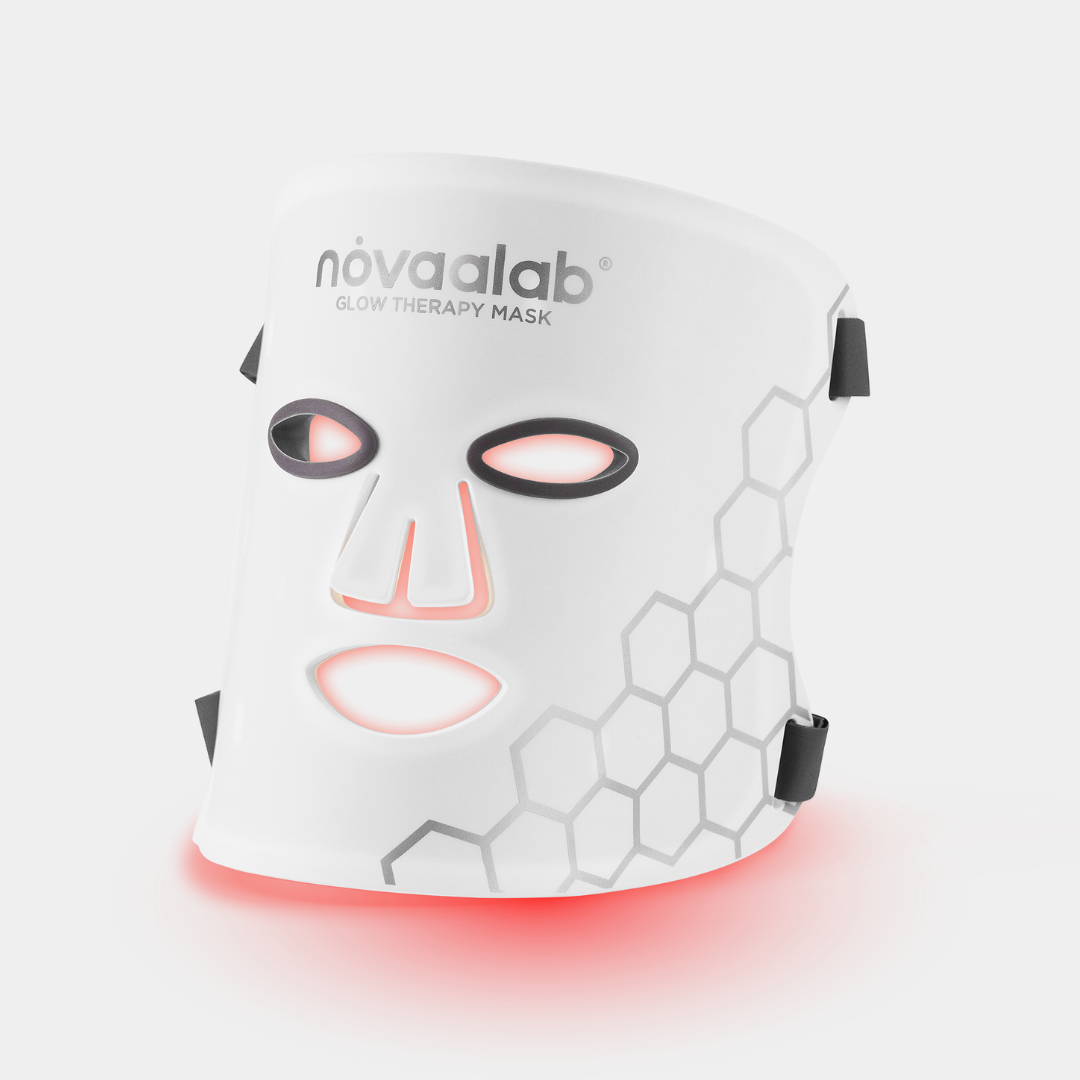
Choosing between a mask and a panel comes down to anatomical requirements and the specific tissues you aim to heal. Facial masks are designed for superficial beauty applications. Because they sit directly on the skin, they minimize the reflection of light off the stratum corneum. But they are inherently low-power devices. Their weak diodes cannot generate the power density required to penetrate past the dermis, rendering them useless for joint paint, deep muscle recovery, or systemic inflammation.
For deep anatomical targets like joint capsules (e.g., knee or shoulder synovium), a high-powered panel is mandatory. Panels deliver a uniform, high-irradiance field (>50 mW/cm² at 810–850 nm) that can comfortably cover large muscle groups or penetrate deep joints. For highly targeted, flexible applications that require joint-wrapping capabilities, portable alternatives like the Novaa Light Pad for Deep Healing offer a middle ground, though they still lack the raw, unyielding power of a solid, desktop array. NovaaLab
Safety Compliance: ANSI Z136.1 Ocular Hazard Zones and Shielding Standards
When deploying high-irradiance near-infrared (NIR) light in a home sanctuary, safety must be engineered into the experience. Near-infrared light (780 nm to 1400 nm) is invisible to the human eye, which means the natural pupillary reflex (blinking) is not triggered. But NIR photons still penetrate the ocular media and reach the retina, where they can cause thermal and photochemical damage under prolonged, unshielded exposure.
The American National Standards Institute (ANSI) Z136.1 standard establishes safe exposure limits and defines Nominal Ocular Hazard Zones (NOHZ) for light-emitting systems. While red light (660 nm) is generally safe for short-duration ambient viewing, high-power NIR emissions require dedicated eye protection. Professional panels should always be operated with certified protective eyewear that offers an Optical Density (OD) rating of 2.0+ at the target wavelengths. This ensures your home retreat remains a place of absolute safety and healing.
Clinical Literature Review: Dose-Response Curves for ATP Upregulation
In photobiomodulation, more is not always better. Biological tissues follow a biphasic dose-response curve, historically known as the Arndt-Schulz curve. At very low energy doses, there is insufficient stimulus to trigger mitochondrial activity. As the energy dose (measured in Joules, J/cm²) increases, cell proliferation, ATP synthesis, and tissue repair increase up to an optimal peak. But if the energy dose exceeds this peak, the positive response diminishes, and high doses can actually inhibit cellular activity or induce oxidative stress.
Achieving the optimal clinical dose requires calculating the exact irradiance of your device and the exposure time. For dermal fibroblasts, literature suggests an optimal energy dose of 2 to 10 J/cm² to stimulate collagen production. For deeper synovial fibroblasts in joint capsules, a much higher surface dose (typically 30 to 60 J/cm²) is required because only a tiny fraction of the photons survive the journey through overlying tissue layers. High-irradiance panels allow you to hit these deep-tissue targets in short, efficient 10-minute sessions, whereas low-power masks would require hours of continuous exposure to deliver equivalent deep-tissue energy. NovaaLab
Decision Matrix: Device Selection Based on Primary Recovery
Investing in your health should be an inspiring and frictionless experience. When selecting your home device, the choice between a targeted mask and a high-performance panel depends entirely on your primary wellness goals. If your sole focus is facial aesthetics, a low-power mask is a convenient option. But if you seek a true lifestyle upgrade, one that tackles chronic joint pain, speeds up athletic recovery, boosts cellular energy, and offers clinical-grade facial rejuvenation, a high-power desktop panel is the undisputed winner.
To make this premier investment completely risk-free, SaunaLogic offers flexible financing options starting from just $19/month, alongside free shipping and an industry-leading lifetime warranty. This guarantees that your private sanctuary of cellular healing remains a reliable asset for years to come, giving you peace of mind alongside modern physical restoration.
Frequently Asked Questions
Can red light therapy masks be used for muscle recovery and joint pain?
No, facial masks are low-power devices designed only for superficial beauty applications. Because their weak diodes cannot generate the power density required to penetrate past the dermis, they are useless for treating joint pain, deep muscle recovery, or systemic inflammation. Deep anatomical targets instead require a high-powered panel to deliver the necessary photon density.
How deep do red and near-infrared light wavelengths penetrate the body?
Red light operating at 660 nm reaches a superficial depth of 5 to 8 mm, making it ideal for targeting the skin's dermal extracellular matrix. In contrast, near-infrared light at 810–830 nm penetrates much deeper, reaching 20 to 40 mm into deep joint capsules, connective tissue, and muscle fibers. To reach these deeper targets, a high power density is required.
Why do red light panels deliver more therapeutic energy than flexible masks?
Panels feature flat array optics with precise beam angles, typically 60 degrees, which focus light directly forward to minimize divergence and maximize energy delivery at a distance. Flexible masks lack these focused optics, resulting in rapid beam divergence and a significant loss in therapeutic energy if they are not held directly against the skin. Consequently, panels are much more efficient at delivering the high photon density required for biological healing.
Do I need to wear eye protection when using a near-infrared red light panel?
Yes, high-power near-infrared (NIR) light emissions require certified protective eyewear with an Optical Density (OD) rating of 2.0+ at the target wavelengths. Because NIR light is invisible to the human eye, it does not trigger the natural blinking reflex, meaning its photons can penetrate the eye and cause thermal or photochemical retinal damage during prolonged exposure. While red light at 660 nm is generally safe for short-duration ambient viewing, invisible NIR light requires active shielding.
What happens if a red light therapy session lasts too long?
Biological tissues follow a biphasic dose-response curve, meaning that more is not always better. While an optimal dose stimulates cellular repair, exceeding this threshold causes the positive biological response to diminish. Delivering an excessive energy dose can ultimately inhibit cellular activity or induce harmful oxidative stress.
Related Reading
- Best Red Light Therapy Face Mask: Dose, Eye Safety, and Collagen Claims Compared
- Red Light Therapy Panel vs Infrared Sauna for Muscle Recovery: Which Is Better for the Money?
- Red Light Therapy for Hair Growth: Panel, Cap, Brush, and At-Home Device Comparison
- Best Infrared Sauna With Red Light Therapy: Wavelengths, EMF, and Real Recovery Value
Pros
- Ultra-high irradiance of 120 mW/cm² targets both deep muscle tissue and joints
- Dual-wavelength emission precisely matches mitochondrial CCO absorption peaks
- strong flat array optics prevent beam divergence and energy loss
- Includes premium risk reversal: lifetime warranty and low-interest financing
Cons
- Requires stationary use rather than walking around
- Requires protective eyewear due to high-power near-infrared output
Technical Verdict
The Medical-Grade Desktop Red Light Panel represents the pinnacle of home photobiomodulation engineering. By delivering optimal irradiance and precise spectral tuning, it successfully bypasses the skin's natural barriers to restore mitochondrial energy at a deep cellular level.
→ View Specs & Pricing